
Money stress can narrow your thinking and nudge you toward safer, more reactive choices, and that part has real research behind it. There is no study showing that your nervous system sets your income ceiling, so treat it as one factor alongside skills, offer, market and strategy.
If your income has been flat for years despite the hustle, the courses and the mastermind, it is natural to wonder what is missing. Strategy matters. And so does the state you are in when you price your work, spend on ads, raise your rates or say no to a client who drains you. This article covers what research says about money stress and decisions, where the evidence is limited, and what you can practice.

What money stress does to thinking
The best-known study here is Mani, Mullainathan, Shafir and Zhao (Science, 2013). In a New Jersey mall, roughly 400 people considered either an easy financial scenario (a $150 car repair) or a hard one (a $1,500 repair) while taking cognitive tests. After the hard scenario, lower-income participants did significantly worse, while higher-income participants were not affected. In a second part, 464 sugarcane farmers in India took the same tests before and after their harvest, and all performed better after it, when money was less tight.
The authors argue that worrying about money uses up mental bandwidth, leaving less for everything else, and they describe this as distinct from stress. Two cautions apply. The farmers were compared with themselves over time, and the wider scarcity literature is uneven: an audit of that research (O’Donnell and colleagues, PNAS, 2021) found that replicability varied widely, with some studies holding up well and others clearly failing. Also, these studies focus on people short of money. They do not tell us that a business owner earning $250,000 is held back by the same effect.
Why the sure thing can feel better than the better bet
Prospect theory (Kahneman and Tversky, 1979) describes how people typically weigh losses more heavily than equal gains and give extra weight to outcomes that feel certain. That is a description of behavior across many people. It is not a finding about anyone’s nervous system, and it does not show that a particular body state produces it.
A 2025 brain imaging study of betrayal aversion (Carbo-Valverde and colleagues, Brain Imaging and Behavior) compared 121 adults aged 18 to 33 and found that people with high and low betrayal aversion differed in some regional brain volumes, including insular volume, which was higher in the low-aversion group. The study is correlational, the sample is young, and the two groups differed in gender balance. It was about trust in digital transactions, not income, so it cannot tell us what limits anyone’s earnings.

Body signals and arousal in financial decisions
Kandasamy and colleagues (Scientific Reports, 2016) studied 18 male hedge fund traders and 48 student controls. Among the traders, better heartbeat detection was linked to higher profits and to more years surviving in the job. It is a small, correlational study at one firm, so it cannot show that learning to sense your heartbeat would raise your income. It does fit a simple idea worth testing in your own life: noticing your body can be useful information when money is on the line.
Nuiten and colleagues (Communications Biology, 2026) studied pupil-linked arousal in 28 healthy young men in a visual detection task. Higher baseline arousal was linked to a more liberal bias, meaning more willingness to answer “yes, it is there,” and strategic adjustments were weakest during moments of high momentary arousal. This study is not about wealth, income or business, and the authors note the pupil findings are correlational. It also does not support the idea that high arousal always makes people avoid risk. What it shows is that arousal can tilt judgment in a simple perception task.
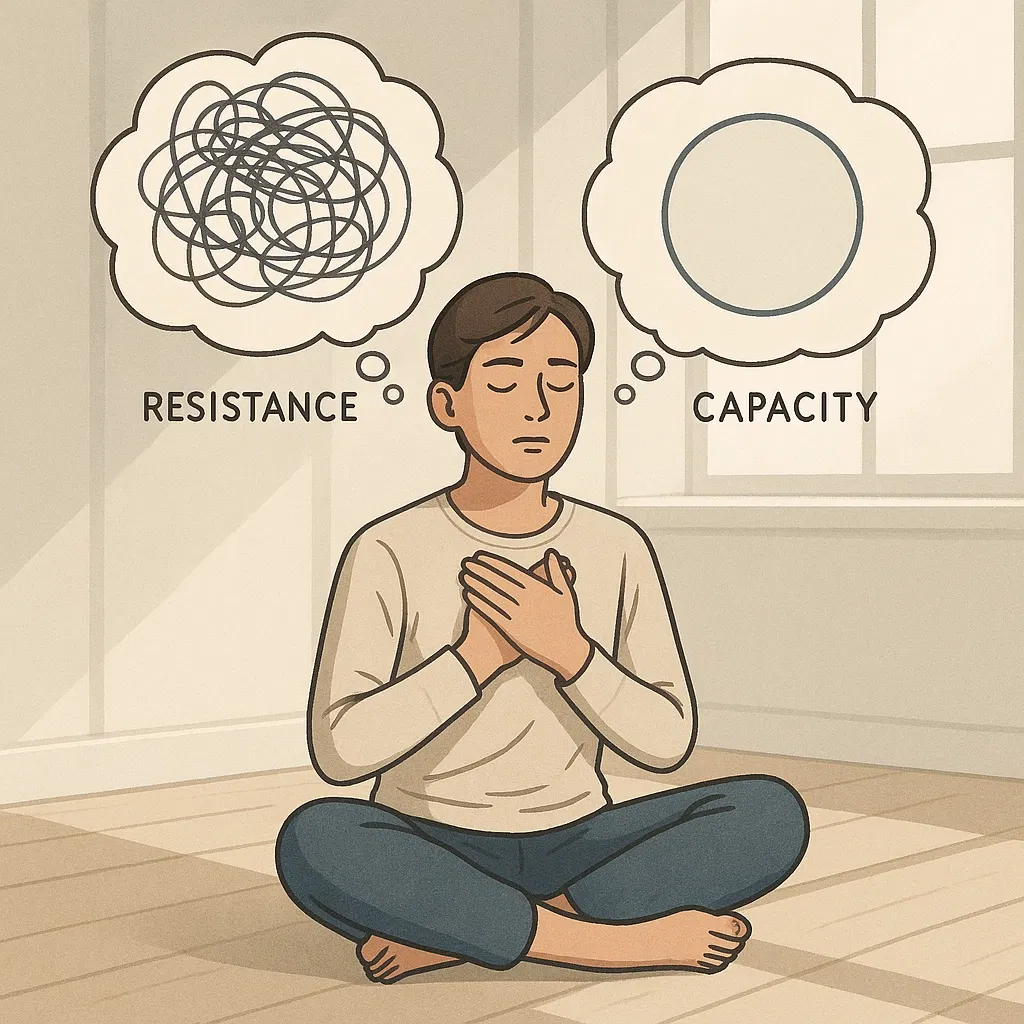
What to do before a money decision
These are low-risk practices for decision quality, not a way to raise your income on their own.
1. Slow your exhale for 3 to 5 minutes
Breathe in through your nose for about four seconds, then out slowly for six to eight. A 2022 systematic review and meta-analysis by Laborde and colleagues (223 studies) reported increases in vagally mediated heart rate variability with voluntary slow breathing. In a randomized study (Balban and colleagues, Cell Reports Medicine, 2023), five minutes a day of cyclic sighing for about a month improved mood and lowered respiratory rate more than mindfulness meditation. Cyclic sighing is a full nose inhale, a short second sip of air, then a long slow exhale through the mouth. Stop if you feel lightheaded, and check with your doctor first if you have a heart or breathing condition.
2. Separate the feeling from the decision
On paper, write one line for what you feel (“I feel tight about raising my price”) and one line for what the numbers say. Let both be true. This is a common coaching practice, not a finding from the studies above.
3. Set your rules before the hot moment
Decide your minimum price, your maximum ad spend and your walk-away line when you are calm. Then you are following a plan instead of negotiating with a racing heart.
4. Protect your sleep before big calls
A 2025 scoping review of 25 studies (Agyapong-Opoku and colleagues, Behavioral Sciences) found that sleep loss appears to impair decision-making, and many studies reported riskier choices. A few, particularly on economic tasks, found no significant effect, so the evidence is mixed. Where you can, avoid irreversible money decisions on very little sleep.
5. Orient and move
Look slowly around the room and name five things you see. Walk for five minutes. No study here promises an outcome. These are simple ways to bring your attention back to the present before you decide.
If money worry is constant or affecting your health, it is worth talking with a licensed professional or a financial counselor as well.
What the research does and does not show
- It does show: financial worry can reduce performance on cognitive tasks in some studies; people often prefer certain outcomes and dislike losses; slow breathing is associated with higher HRV; and one randomized study found a short daily breathing practice improved self-reported mood.
- It does not show: that your nervous system caps your income, that any brain structure decides whether you earn more, or that any practice here will raise your earnings.
- Keep in mind: several of these studies are small, correlational or hard to replicate, and none was designed to study entrepreneurs’ revenue.
Where to go from here
At Satori Prime we put it this way: stop trying to make yourself feel better and simply get better at feeling.™ Our Nervous System Reset Protocol is a short daily self-regulation practice. It is education and coaching for personal development, not medical or financial advice, and we do not promise specific income results.
- Start the Protocol: Discover How to release your old patterns in just 9 minutes.
- Identify Your Block: Download our survival patterns guide to see which patterns may be showing up around money.
- Get Personal Support: Book your call with our team to map out your next steps.
Special Offer: For a limited time, you can get 50% OFF our flagship Nervous System Mastery (Level 1 Intro) program.
Click here to claim your 50% discount and start your transformation today.
Sources
- Mani, Mullainathan, Shafir and Zhao, Poverty impedes cognitive function, Science, 2013 (Princeton University summary)
- O’Donnell et al., Empirical audit and review and an assessment of evidentiary value in research on the psychological consequences of scarcity, PNAS 118(44), 2021
- Kahneman and Tversky, Prospect Theory: An Analysis of Decision under Risk, Econometrica, 1979
- Carbo-Valverde, Martin-Rios and Rodriguez-Fernandez, Exploring neuroanatomy and neuropsychology in digital financial decision-making: betrayal aversion and risk behavior, Brain Imaging and Behavior 19:357-364, 2025
- University of Cambridge, Gut feelings help make more successful financial traders (summary of Kandasamy et al., Scientific Reports, 2016)
- Nuiten et al., Phasic and tonic arousal distinctly shape human decision bias, Communications Biology 9:553, 2026
- Laborde et al., Effects of voluntary slow breathing on heart rate and heart rate variability: a systematic review and meta-analysis, Neuroscience and Biobehavioral Reviews, 2022
- Balban et al., Brief structured respiration practices enhance mood and reduce physiological arousal, Cell Reports Medicine, 2023
- Agyapong-Opoku et al., Examining the Effects of Sleep Deprivation on Decision-Making: A Scoping Review, Behavioral Sciences 15(6):823, 2025