 Satori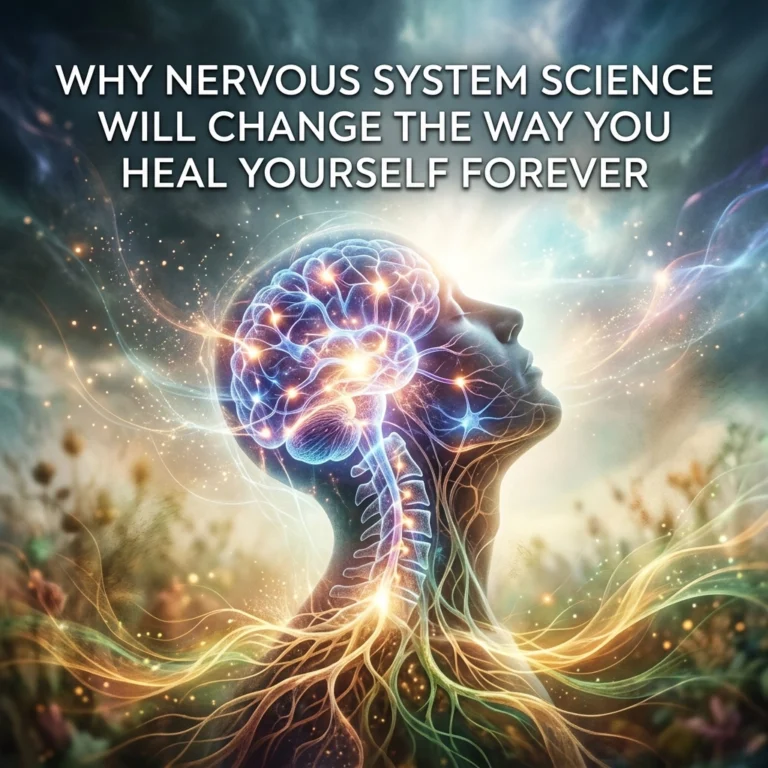
Most people try to heal from the top down.
They think their way out of pain. They journal harder. They reframe faster. They stack affirmations like bricks and hope it becomes a home.
And then, out of nowhere, the same anxiety hits. The same shutdown. The same spiral. The same “Why am I like this?” question, whispered into the ceiling at 2:17am.
Here’s the truth that changes everything:
Your healing isn’t failing because you’re broken.
Your healing is failing because you’re trying to use mindset to solve a biology problem.
Nervous system science makes this visible. It shows you the hidden operating system running beneath your thoughts, deciding what feels safe, what feels threatening, what you can tolerate, what you avoid, and what you call “personality” even though it’s often just physiology.
This is the pivot:
Stop trying to make yourself feel better and simply get better at feeling.™
That’s regulation. That’s nervous system health. That’s how to heal yourself in a way that lasts.
Your nervous system is the “reality engine” that decides what you can heal
Your nervous system is not just about stress or calm.
It’s the master network that coordinates:
- Threat detection (amygdala + limbic circuits)
- Attention and focus (prefrontal cortex)
- Emotional regulation (front-to-limbic connectivity)
- Breathing, heart rate, digestion (autonomic nervous system)
- Hormones and metabolism (HPA axis + endocrine signaling)
- Immune activity and inflammation (neuroimmune pathways)
So when your nervous system is dysregulated, it’s not just “in your head.”
It’s in your blood pressure. Your gut motility. Your sleep architecture. Your inflammatory patterns. Your cravings. Your libido. Your capacity for joy. Your ability to connect without bracing for impact.
Chronic stress, especially the kind rooted in unresolved trauma, can keep your system stuck in a loop of sympathetic activation (fight/flight) or dorsal vagal shutdown (collapse/freeze). Over time, that loop doesn’t just feel bad. It can reshape your baseline.
This is why nervous system regulation isn’t “self-care.” It’s infrastructure.
When your system learns safety again, healing accelerates across multiple systems at once, because the network is finally receiving the signal: we can repair now.
Why mindset work isn’t enough (even when it’s “working”)
Mindset work can be powerful. But it has a ceiling.
Because mindset mostly operates through the cortical layer, language, reasoning, meaning-making. And trauma doesn’t live primarily in language. Trauma lives in survival circuitry.
You can tell yourself:
- “I’m safe.”
- “It’s in the past.”
- “I don’t need to people-please.”
- “I can relax.”
…and still feel your body tighten, your chest compress, your breath go shallow, your throat close, your mind race.
That’s not a character flaw. That’s state.
A regulated nervous system can hold complexity. A dysregulated nervous system can’t. When the body is in threat mode, your brain prioritizes survival, not insight.
So you end up in the most frustrating place:
You understand your patterns… but you can’t stop them.
That’s because understanding is not the same as regulation.
Regulation is what gives mindset work traction. Without it, mindset becomes a mental gym routine performed inside a burning building.
Regulation: the biology of “I can be with this”
Nervous system regulation is your capacity to move through life without getting hijacked, without your body dragging you into old survival strategies.
Regulation doesn’t mean you’re calm all the time.
It means you have flexibility:
- You can feel anxiety without becoming anxiety.
- You can feel anger without exploding or collapsing.
- You can feel sadness without drowning in it.
- You can feel joy without waiting for the other shoe to drop.
In nervous system terms, we’re talking about:
- Autonomic balance: sympathetic (mobilize) + parasympathetic (restore) working in healthy rhythm
- Vagal tone: the “brake” that helps you return to baseline
- Window of tolerance: your capacity to feel sensations and emotions without flipping into panic or shutdown
Healing trauma is often less about “getting rid of” feelings and more about expanding your capacity to feel safely.
Because what you can feel, you can metabolize.
What you can’t feel, you’ll repeat.

Trauma: when your body learns the wrong lesson and calls it “normal”
Trauma isn’t defined only by what happened.
Trauma is what happens inside you when your nervous system experiences too much, too fast, too soon… with too little support.
And then it adapts.
Brilliantly.
Trauma responses are not weaknesses. They’re strategies your system used to keep you alive:
- Hypervigilance = “If I stay alert, I can prevent pain.”
- People-pleasing = “If they’re happy, I’m safe.”
- Perfectionism = “If I get it right, I won’t be attacked.”
- Numbing = “If I don’t feel, I won’t break.”
- Overthinking = “If I analyze enough, I can control uncertainty.”
But over time, these strategies become a cage that looks like a personality.
Nervous system science gives you the map: it shows you where your system is stuck, and how to guide it back into flow, without forcing it, shaming it, or bypassing it.
Neuroplasticity: you’re not stuck, you’re trained
Here’s the psychedelic part (and it’s real science):
Your brain is plastic. Your nervous system is trainable. Your baseline is not destiny.
Brain imaging research has shown that repeated practices like mindfulness and attention training can create structural and functional changes in regions tied to emotional regulation and focus. You’re not just “coping.” You’re changing circuitry.
That’s the core promise of neuroplasticity:
- Repetition strengthens pathways.
- Safety unlocks learning.
- Connection accelerates change.
But neuroplasticity isn’t just about positive thinking. It’s about state-dependent learning. If you practice new behaviors while your body is in threat mode, your system often records the lesson as: life is dangerous, even when I’m trying to heal.
The key is to train your nervous system in a way that it can actually receive.
That’s why we focus on regulation first.
The Nervous System Reset Protocol: heal from the roots, not the branches
At Satori Prime, we’re not interested in quick hacks that make you feel better for an hour.
We’re interested in nervous system health, the kind that changes your identity from the inside out because your body stops living like the world is a warzone.
The Nervous System Reset Protocol is a simple framework for retraining your system through consistent, nervous-system-informed reps.
Think of it like rewiring your internal electrical grid: less sparking, fewer outages, more usable power.
1) Stabilize: create safety in the body (not just in the story)
Before you process deep emotion, you build capacity.
Stabilization looks like:
- Downshifting arousal (breath + posture + sensory cues)
- Orienting to the present (teaching the brain: “we’re here, not there”)
- Building predictable routines (your system loves rhythm)
This isn’t glamorous, but it’s foundational. A nervous system that doesn’t feel safe will not surrender its defenses, no matter how good your affirmations are.
2) Train regulation: expand your window of tolerance
This is the heart of it: learning to ride sensation without getting yanked into old patterns.
Tools here include:
- Breathwork (slow exhale patterns to support parasympathetic activation)
- Grounding (feet, pressure, temperature, simple, primal signals)
- Somatic tracking (naming sensation without amplifying it)
- Micro-mobilization (shaking, walking, gentle movement to discharge activation)
The goal isn’t to erase intensity. It’s to build the skill of staying with it.
You’re becoming someone who can feel more… without becoming less functional.
3) Repattern: install new responses through repetition
Once your system can stay present, you can introduce new choices:
- Boundaries that don’t trigger guilt storms
- Conflict that doesn’t feel like abandonment
- Rest that doesn’t feel like danger
- Visibility that doesn’t feel like exposure
This is where mindset work becomes powerful again, because now your body can cooperate with your beliefs.
4) Integrate: make it social, embodied, and real
Healing doesn’t happen in isolation. Your nervous system is relational.
Co-regulation, safe connection, teaches the body what safety feels like faster than any solo technique.
Integration looks like:
- Practicing new states around other humans
- Repairing after rupture
- Receiving support without bracing
- Letting joy land in the body (yes, that’s part of trauma work)

The mind-body integration nobody told you about: stress, immunity, and inflammation
Nervous system dysregulation doesn’t stay politely in the “emotional” category.
Chronic fight-or-flight signaling can contribute to:
- disrupted sleep and recovery
- elevated blood pressure and cardiovascular strain
- hormone imbalances and metabolic changes
- inflammatory patterns (your system staying “on guard” internally)
On the flip side, when you train regulation: through breath, safety cues, connection, and consistent practice: you’re not just calming down.
You’re telling the body:
- “You can digest now.”
- “You can repair now.”
- “You can sleep deeply now.”
- “You can turn down the alarms now.”
That’s why nervous system science is so revolutionary for healing: it connects the dots between your emotions and your biology, between your story and your cells.
“How do I heal myself?” Start here: 5 punchy reset practices
These aren’t magical. They’re mechanical. That’s the point.
1) The 30-second orienting reset
Look around the room slowly. Turn your head. Let your eyes land on objects. Name 5 neutral things you see.
This is a signal to your survival brain: present moment confirmed.
2) The long-exhale breath (2 minutes)
Inhale through the nose for 4. Exhale through the mouth for 6–8.
Longer exhales support parasympathetic downshifting. You’re literally changing your internal chemistry.
3) Pressure + contact grounding (60 seconds)
Press your feet into the ground. Press your palms together. Or place one hand on your chest, one on your belly.
Steady pressure is a primal cue of containment: I am here, I have edges, I am held.
4) Name the sensation, not the story (90 seconds)
Instead of “I’m freaking out,” try:
- “Heat in chest.”
- “Buzzing in arms.”
- “Tight throat.”
- “Fast thoughts.”
This reduces fusion and increases regulation. You’re tracking the weather without becoming the storm.
5) Complete the stress cycle (2–5 minutes)
Walk briskly. Shake your hands. Do slow squats. Stretch. Let the body discharge what the mind keeps recycling.
Your body was built to move stress through. Give it the exit.

The psychedelic truth: your emotions are energy, your body is the canvas
If you zoom out far enough, healing becomes almost cosmic.
Not in a woo-woo way: in a nervous-system way.
Your inner world is a living, electrical ecosystem. Signals firing. Hormones pulsing. Networks syncing like constellations. Your breath is a metronome. Your heartbeat is a drum. Your sensations are colors in motion.
When you stop trying to “think” your way into safety and start training your body to experience safety, you don’t just feel better.
You become more alive.
You become more you: without the armor.
And the philosophy becomes practical:
Stop trying to make yourself feel better and simply get better at feeling.™
Because the goal isn’t permanent happiness.
The goal is capacity.
To feel it all: grief, desire, fear, power, tenderness: without abandoning yourself.
That’s nervous system regulation. That’s healing. That’s the forever change.
If you want support applying this work with structure, you can explore what we’re building at Satori Prime through our main hub at https://satoriprime.com or go straight to a conversation here: https://satoriprime.com/book-your-call