 Satori
Listen, we’ve been lied to.
For decades, the personal development world has been shouting from the rooftops that "mindset is everything." They told you that if you just thought better thoughts, recited more affirmations, or "manifested" harder, your life would magically transform.
But here’s the cold, hard truth: Your mindset doesn't stand a chance against a dysregulated biology.
If your nervous system is stuck in a state of high-alert, your brain literally shuts down the parts of itself responsible for logic, creativity, and "positive thinking." You aren't "broken," and you don't have a "weak will." You have a biological system that is trying to protect you from a threat it thinks is happening right now, even if that threat is just a passive-aggressive email from your boss.
At Satori Prime, we’ve spent years helping high performers realize that the secret to a liberated life isn't thinking more, it's feeling better. Or, as we like to say: "Stop trying to make yourself feel better and simply get better at feeling."™
If you feel like you’re constantly hitting a ceiling in your growth, it’s likely because you’re making one of these seven mistakes with your nervous system health.
1. Trying to "Think" Your Way Out of a Biological Response
This is the biggest trap of all. When you are in a state of fight, flight, or freeze, your prefrontal cortex, the part of the brain that handles rational thought, goes offline.
Imagine trying to install a software update on a computer that’s currently on fire. The "software" (your mindset) isn't the problem; the "hardware" (your nervous system) is melting. If you’re triggered, anxious, or overwhelmed, repeating "I am calm" is like putting a band-aid on a gunshot wound.
The Fix: Shift from "Top-Down" to "Bottom-Up" processing. Instead of trying to change the thought, address the physical sensation in your body. Where do you feel the tightness? The heat? The pressure? When you regulate the body first, the mind follows naturally.

(Visual: An abstract, psychedelic representation of neural pathways glowing with vibrant neon colors, shifting from chaotic jagged lines to smooth, flowing waves.)
2. Using "Regulation Tools" as Bypassing Weapons
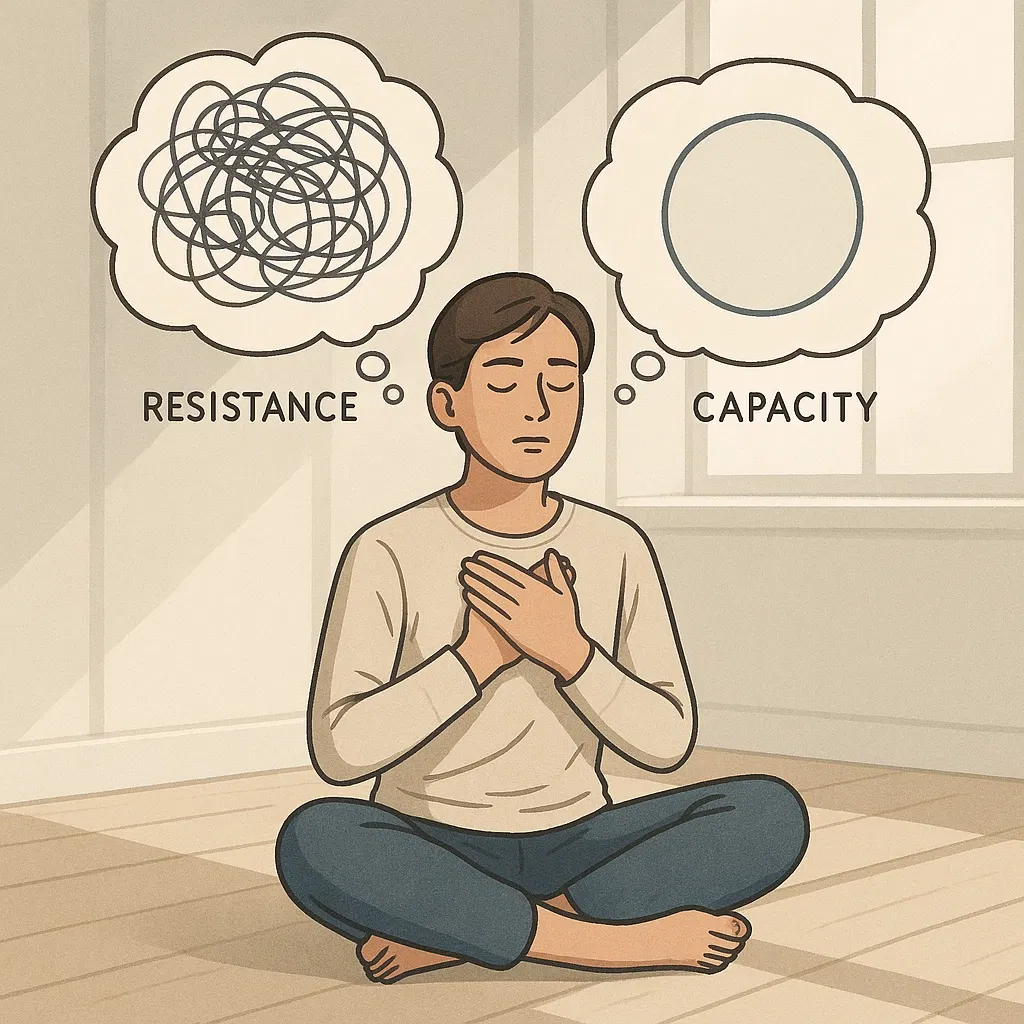
We see this all the time: people using cold plunges, breathwork, or meditation as a way to escape their current state. If you are doing a 4-7-8 breathing technique specifically because you hate how you feel and want it to go away, you are actually reinforcing a state of resistance.
Your nervous system is incredibly smart. It knows when you’re trying to manipulate it. When you use tools to suppress your experience, you’re essentially telling your body, "What you’re feeling right now is dangerous and unacceptable."
The Fix: Use tools to build capacity, not just to find relief. Use the Nervous System Reset Protocol to learn how to sit with the "yuck" without needing to fix it immediately. The goal is to become a bigger container for your emotions.
3. The "Busy" Trap: Glorifying Chronic Stress
In our culture, "busy" is a badge of honor. But in the world of biology, chronic busyness is often just a sophisticated trauma response. It’s called "High-Functioning Freeze" or "Flight." By staying constantly in motion, you never have to feel the underlying restlessness or lack of safety that resides in your body.
If you can’t sit still for ten minutes without reaching for your phone or a snack, your nervous system is likely stuck in a "high idle." You’re burning fuel even when you’re parked. This leads to burnout, low HRV (Heart Rate Variability), and eventually, physical illness.
The Fix: Practice intentional "non-doing." Start with micro-resets. Take two minutes between meetings to just breathe and feel your feet on the floor. No phone. No goals. Just existence.
4. Neglecting the "Social Mammal" Component
Your nervous system doesn't exist in a vacuum. We are biologically wired for co-regulation. This means our nervous systems literally "talk" to each other. If you are trying to heal your trauma or regulate your stress entirely on your own, you’re fighting against millions of years of evolution.
Isolation is a signal of danger to the primitive brain. Many people struggle with nervous system regulation because they lack a "safe harbor", a person or community where their system can truly power down.
The Fix: Seek out environments of high-level safety. Whether it’s a coach, a partner, or a conscious community, prioritize relationships where you don't have to "perform." Learning to co-regulate is the fastest way to train your own system to self-regulate.

5. Treating Symptoms Instead of the Root Biology
Are you dealing with brain fog, digestive issues, or "short fuse" syndrome? Most people go to a doctor for the stomach, a therapist for the anger, and a nutritionist for the fog. While those are helpful, they often miss the common denominator: The Vagus Nerve.
Your nervous system is the command center for every other system in your body. If the command center is sending out a "Red Alert" signal 24/7, your digestion will shut down (to save energy for the "fight"), your reproductive hormones will tank, and your brain will prioritize survival over memory.
The Fix: Stop "hacking" your symptoms and start healing your system. Before you buy another supplement, ask yourself: "Is my body currently in a state of safety or survival?" If you're not sure, take our Nervous System Assessment to see where you actually stand.
6. Living "Head-Up": The Dissociation Habit
Most of us live from the neck up. We treat our bodies like a vehicle that carries our heads from meeting to meeting. This is a form of dissociation. When you lose the "felt sense" of your body, you lose the ability to regulate your nervous system because you’re no longer receiving the data it’s sending you.
Trauma is often stored as "frozen" energy in the tissues. If you aren't embodied, you can't move that energy. You’ll just keep looping through the same patterns, wondering why you’re so stuck despite all the books you’ve read.
The Fix: Embodiment practices are non-negotiable. This isn't just about exercise; it's about sensation. Throughout the day, ask yourself: "What is my body feeling right now?" Not "What am I thinking?" but "What is the texture of my internal experience?"

7. Waiting for "Perfect Conditions" to Heal
You think you’ll start focusing on your nervous system when the kids are older, when the business scales, or when you finally have a week off.
Newsflash: Your nervous system doesn't care about your calendar. It is responding to the current moment. If you wait for the world to become peaceful before you find peace, you will be waiting forever. The world is chaotic. Your job is to develop the internal "shock absorbers" to navigate that chaos without shattering.
The Fix: Integration is the name of the game. You don't need a Himalayan cave; you need a protocol that works in the middle of a grocery store or a boardroom. This is why we created the Nervous System Reset Protocol, to give you the tools to regulate in real-time.
The Science of Why You're Not "Healing"
When we talk about healing, we’re really talking about Neuroplasticity.
Your nervous system has "grooves" in it, patterns of response that have been reinforced for decades. If you’ve spent 30 years reacting to stress with anger or withdrawal, those neural pathways are like eight-lane highways. Trying to "think positive" is like trying to build a new dirt path through a jungle while everyone else is driving 80mph on the highway.
To change the biology, you have to provide the body with a "Corrective Emotional Experience." You have to show the body, not tell it, that it is safe.

(Visual: A surreal, psychedelic landscape where old, decaying structures are being overtaken by glowing, crystalline flora, representing the transformation of old trauma into new growth.)
How to Start Getting Better at Feeling
The path to a regulated nervous system isn't about becoming a Zen monk. It’s about becoming more human. It’s about expanding your capacity to hold the full spectrum of the human experience, the joy, the grief, the boredom, and the "yuck", without being hijacked by any of it.
If you’re ready to stop the endless loop of "fixing" yourself and actually start living, you have to go deeper than mindset. You have to address the biology of your soul.
Your Next Steps:
- Stop the Bypassing: Next time you feel triggered, don't try to "fix" it. Just notice it. Say, "Oh, there’s that tightness in my chest again."
- Check Your Data: Understand how your system is actually performing. Check out our resources on High Performers and the Daily 10-Minute Practice.
- Commit to the Reset: If you're tired of the DIY approach, join us for a Live Workshop where we dive deep into the mechanics of the Nervous System Reset Protocol.
You have spent enough time trying to "make" yourself feel better. It's time to get better at feeling. The liberation you’re looking for isn't on the other side of a thought; it's right here, inside the body you’ve been trying to escape.
Welcome home.