
Most people think relationships are built on communication. They spend thousands of dollars on therapy, read every "how-to" book on active listening, and memorize scripts for "I-statements."
Here is the cold, hard truth: Your words don't mean a damn thing if your nervous system is screaming.
The foundation of every connection in your life: with your partner, your children, your colleagues: isn't what you say. It’s the invisible, bio-electric frequency you are broadcasting into the room. This is the world of co-regulation, and mastering it is the single most important skill you will ever learn if you want to improve relationships and finally be more peaceful.
At Satori Prime, we don't play in the shallow end of "behavioral tips." We go for the root. And the root is your nervous system.
The Nervous System Wi-Fi: Why You Can’t Hide Your Energy
Think of your nervous system as a high-speed Wi-Fi router. You are constantly sending and receiving signals. When you walk into a room, you aren’t just a person; you are a vibrating field of data.
If you are stressed, anxious, or suppressed, your "router" is sending out glitchy, jagged signals. This is why you can say "I’m fine" with a smile, but your partner still feels on edge, or your toddler suddenly decides to have a meltdown. They aren't listening to your words; they are downloading your data.
Co-regulation is the process by which two nervous systems influence each other. In a healthy connection, one regulated system can act as an anchor for a dysregulated one. But for most people, the opposite happens: we become "thermometers" instead of "thermostats." We simply react to the temperature of the person in front of us. If they’re hot, we burn up. If they’re cold, we freeze.
Mastering co-regulation means becoming the thermostat. It means having the capacity to stay grounded so that others can find their way back to peace through your presence.
The Satori Philosophy: Stop Trying to Feel Better
We have a saying here that flips the entire self-help industry on its head: "Stop trying to make yourself feel better and simply get better at feeling."™
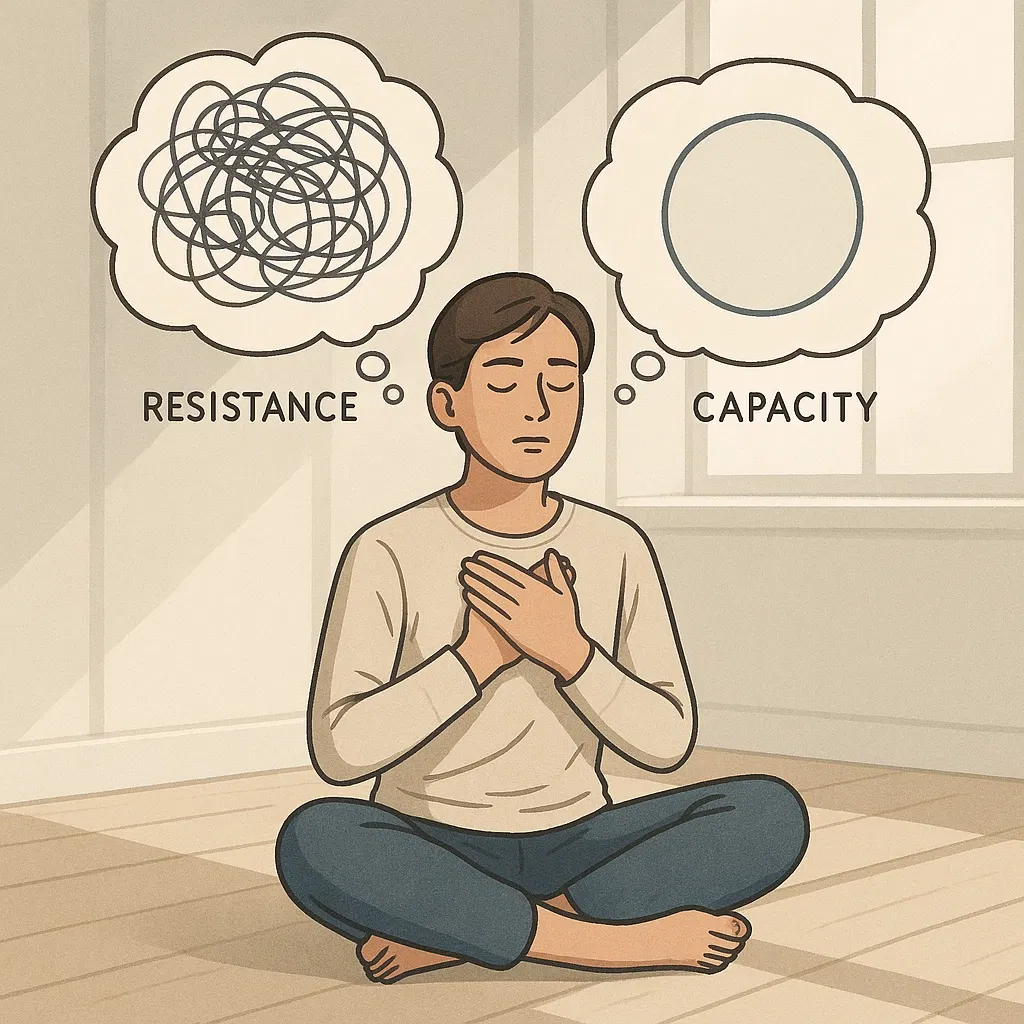
The obsession with "feeling better" is actually what keeps you stuck. When you try to force yourself into a state of "calm" because you can’t handle the discomfort of your own anxiety, you are creating a secondary layer of stress. You are resisting reality.
When you resist your internal state, you become rigid. A rigid nervous system cannot co-regulate; it can only collide.
To be more peaceful, you have to expand your internal "container." You have to develop the capacity to sit with the fire, the grief, the rage, and the chaos without needing to fix it or run from it. When you get better at feeling the intensity of life, your nervous system becomes a vast, open ocean. A storm might happen on the surface, but the depths remain unshakable.
This is why your transformation might not be working: you’re likely trying to think your way out of a feeling problem.
The Psychedelic Geometry of Connection
Imagine, for a moment, that your connection with another human is a living fractal. When you are regulated, the geometry is symmetrical, flowing, and vibrant. The colors are harmonized. There is a sense of "oneness" that transcends the physical body.
But when you lose touch with your own system, the fractal shatters. The imagery becomes jagged, dark, and repetitive. You get caught in loops: the same arguments, the same resentments, the same walls.

To heal the connection, you don't try to fix the fractal. You go back to the source of the light. You regulate the projector. When you bring yourself back into alignment, the external world: the "hallucination" of your relationships: naturally begins to reconfigure into something beautiful.
How to Be a Better Parent Through Co-Regulation
If you have kids, this is the most important thing you will ever read: Your children do not listen to you; they feel you.
A child’s nervous system is essentially an extension of the parent’s for the first several years of their life. They don't have the hardware yet to regulate themselves. They "borrow" your nervous system to find safety.
If you want to be a better parent, you have to stop focusing on their behavior and start focusing on your internal atmosphere. When your child is screaming, their nervous system is in a state of "threat." If you respond with anger, frustration, or a desperate need to make them stop, you are essentially adding gasoline to the fire. You are confirming to their biology that there is, indeed, something to be afraid of.
But when you have done the work to navigate your own system, you can stand in the middle of their tantrum and remain a calm, solid mountain. You don't need them to change for you to feel okay. That is the ultimate gift of co-regulation. You provide the frequency of safety, and eventually, their system will "entrain" to yours. They will find their way back to the shore because you are the shore.
Relationship Alignment: Ending the Tug-of-War
In adult relationships, co-regulation is the secret sauce to intimacy. Most couples are in a constant tug-of-war, each waiting for the other to be "the calm one" so they can finally relax.
"I'll be nice when you stop being a jerk."
"I'll open up when you stop being so critical."
This is a recipe for disaster. It’s two starving people waiting for the other to cook dinner.
Mastering co-regulation means taking 100% responsibility for your own internal state. It’s about realizing that you have the power to shift the entire dynamic of a room just by how you breathe and how you inhabit your body. When you stop reacting and start responding from a place of grounded presence, you break the cycle of escalation.
You become a safe harbor. And when a partner feels safe, they don't need their armor. The walls come down, not because you asked them to, but because the "threat" they were sensing in your dysregulation has vanished.

Practical Steps to Master the Invisible
How do you actually do this? How do you move from theory to embodiment?
- Interoception is King: Start paying attention to the physical sensations in your body before you speak. Is your chest tight? Is your jaw clenched? That is your nervous system preparing for battle. Don't try to change it: just notice it.
- The 5-Second Pause: Before responding to a trigger, give yourself five seconds of deep, belly breathing. This signals to your brain that you aren't being chased by a tiger.
- Check Your Broadcast: Ask yourself, "What frequency am I sending out right now?" If you wouldn't want to receive it, don't send it.
- Get Support: This isn't easy to do alone. Our 28-Day Navigation program is designed specifically to help you rewire these unconscious patterns.
The Visionary Path Forward
We are living in a time of unprecedented dysregulation. The world is loud, fast, and demanding. If you don't master your own system, you will spend your entire life being a victim of your environment and the moods of the people around you. You will feel like life is passing you by because you are too busy surviving to actually live.
But there is another way.
Imagine a world where you are so anchored in your own presence that nothing can throw you off. Imagine being the person who brings peace into every room they enter. Imagine your children growing up with the deep-seated knowledge that they are safe, simply because you are there.
This is the power of co-regulation. It is the bridge to a new way of being human. It’s time to stop talking and start feeling. It’s time to book your call and step into the next version of yourself.
The world doesn't need more "good communicators." It needs more regulated souls.
