 Satori
Most people think high performance is a matter of willpower. They think it’s about waking up at 4 AM, crushing three espressos, and "hustling" until their eyes bleed. They treat their minds like software that needs an update, completely forgetting that the software is running on a biological machine: your nervous system.
If your "hardware" is fried, glitchy, or stuck in a low-power mode, no amount of productivity "hacks" will save you.
At Satori Prime, we don’t do "hacks." We do transformation. And the foundation of that transformation is the realization that your nervous system is the literal gatekeeper to your bank account, your leadership potential, and your ability to access flow states on demand.
If you want to play a bigger game, you have to stop trying to bypass your biology. You have to learn how to lead it.
The "Better at Feeling" Paradox
Here is the Satori Prime philosophy in one sentence: "Stop trying to make yourself feel better and simply get better at feeling."™
The average person spends their entire life running away from discomfort. They drink to numb, they scroll to distract, and they meditate to "calm down" because they can’t stand the electricity of their own existence.
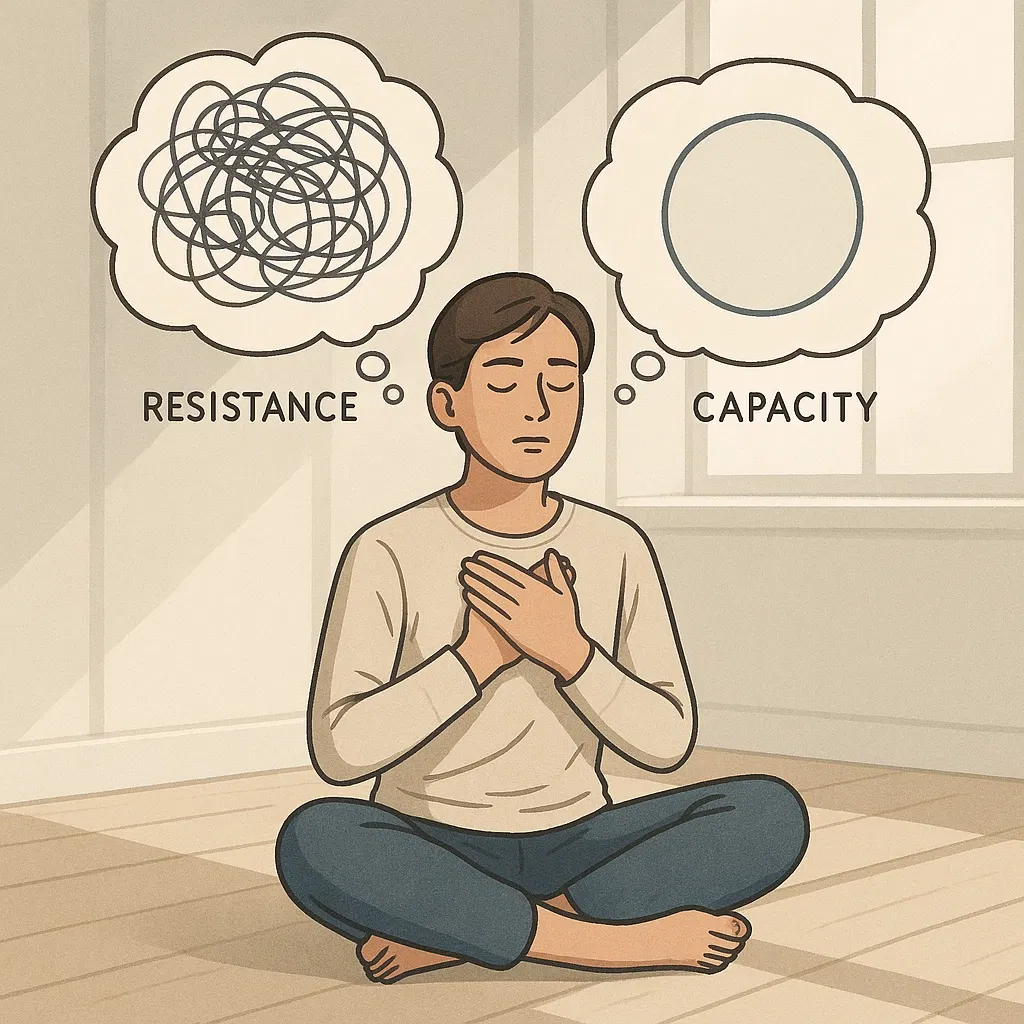
But here’s the visionary truth: Your capacity to hold "uncomfortable" sensations is directly proportional to your capacity to hold success.
If you can’t handle the jittery, electric hum of uncertainty, you’ll never take the risks required to build a seven-figure business. If you can't handle the heat of a difficult conversation, you'll never be a world-class leader. When you try to "feel better," you’re essentially telling your nervous system that certain states are "bad" or "dangerous." This creates internal friction.
High performance is frictionless. To get there, you have to expand your container. You have to get better at feeling the intensity of life without snapping.

Your Money Mindset is a Physiological State
People ask us all the time: "How do I make more money?" They expect a marketing strategy or a sales script. Instead, we look at their nervous system.
Money is energy. If your system is stuck in a state of contraction: what we call the "survival state": your brain literally cannot see the opportunities in front of you. When you’re in a sympathetic (fight/flight) or dorsal (freeze/collapse) state, your prefrontal cortex: the part of the brain responsible for vision and strategy: goes offline.
How to make more money with your nervous system:
- Safety First: If your system perceives a lack of money as a threat to your survival, it will keep you small and safe. You’ll self-sabotage to avoid the "danger" of growth.
- Expansion over Strategy: Wealth requires the ability to be "expansive" in the face of big numbers. If a $100k contract makes your chest tighten and your breath shallow, you aren’t ready for it. Your system will push it away.
- The Wealth Container: By regulating your nervous system, you increase your "threshold for the extraordinary." You become a person who can hold large sums of money without the system-wide panic that leads to reckless spending or paralyzing fear.
Financial success isn't just about what you do; it’s about the state you’re in while you do it.
The 4-Part Framework for High Performance
To unlock the next level of your life, you need a repeatable process. We’ve distilled this into a four-part framework that bridges the gap between ancient wisdom and modern neuroscience.
1. Regulate: The CEO State
Before you can lead a company, you must lead your own physiology. According to Polyvagal Theory, your system has three main modes. Most high-performing leaders are accidentally living in a state of "high-functioning anxiety" (sympathetic overdrive).
High performance lives in the Ventral Vagal zone: the state of safety and engagement. This is where you are alert, focused, and socially connected.
- The Rep: Use long exhales to signal safety to your brain.
- The Result: You move from being a reactive manager to a visionary leader.
2. Recruit: Efficiency is Power
Your brain is a metabolic hog. It wants to be efficient, not necessarily proficient. If you don’t train your system to recruit the right "neural circuits" for a task, you’ll waste energy. High-performing leaders know how to flip the switch. They can go from a relaxed, playful state to a razor-sharp "war room" state in seconds because they’ve trained the neural recruitment.
3. Refine: Precision Under Pressure
This is where the elite separate themselves from the amateurs. Can you maintain your coordination and your flow states when the stakes are high?
Refining your system means exposing yourself to "safe stress." You practice your craft under pressure so your nervous system learns that "intensity" does not equal "danger."
4. Recover & Reinforce: The Sustainable Edge
You cannot redline a car forever without an oil change. High performance is unsustainable without active recovery. This isn't just "sleeping"; it's a deliberate downshifting of the nervous system.
If you don't recover, your baseline for stress rises until you burn out. If you want to stay at the top, you must treat your downtime with the same discipline as your "uptime."
Leadership and the ROI of Presence
In the modern world, "presence" is the ultimate currency.
Think about the best leaders you’ve ever met. They didn't necessarily have the best words; they had the best presence. When they walked into a room, the room settled. That is a regulated nervous system in action.
High performing leaders understand "co-regulation." If you are the leader of a team and your nervous system is fried, your team will subconsciously pick up on that stress. Their performance will drop. They will become more defensive and less creative.
When you regulate yourself, you provide a "tether" for everyone else. Your calm becomes their calm. Your clarity becomes their clarity. This is the visionary way to lead. It’s not about control; it’s about resonance.

Flow States: The Psychedelic Reality of Peak Performance
When people talk about flow states, they often describe it as a "peak experience." It feels like time slows down, the self disappears, and your output becomes effortless.
From a nervous system perspective, flow is the "sweet spot" of arousal. It’s where you have enough "juice" (sympathetic energy) to be sharp, but enough "safety" (ventral vagal energy) to remain fluid.
To enter flow, you have to let go of the "controller." You have to trust your system. This is where the abstract and the biological meet. It feels like a psychedelic expansion of your capabilities because, in a way, it is. Your brain is releasing a cocktail of dopamine, endorphins, and anandamide: the "bliss molecule."
But you can't force flow. You can only create the conditions for it. And those conditions are built on a foundation of nervous system regulation.
Are You Running a Survival Pattern?
Most people are trapped in what we call "Survival Patterns." These are subconscious loops programmed into your nervous system during childhood to keep you safe. Maybe you please people to avoid conflict, or you work yourself to exhaustion to prove your worth.
These patterns were useful when you were five. They are a death sentence for your high-performance goals now.
If you feel like you’re hitting a ceiling: financially, professionally, or emotionally: it’s likely a survival pattern masquerading as a "personality trait." You aren't "lazy" or "bad at sales"; your nervous system is simply trying to protect you from the perceived threat of being seen or being rejected.
To break the ceiling, you have to rewrite the pattern.
Stop guessing and start leading your biology.
If you’re ready to stop the "hustle" and start the expansion, you need to understand the hidden scripts running your life. We’ve put together a guide to help you identify the specific patterns that are throttling your performance.
Download the Free Survival Patterns Guide Here
The Path Forward
The future of personal development isn't found in more information. It’s found in more embodiment.
The high performer of the future is a "nervous system athlete." They know how to shift states, how to handle the "heat" of big money and big leadership, and how to recover with intensity.
Stop trying to fix your mind with your mind. It’s like trying to use a hammer to fix a broken lightbulb. Go deeper. Go into the body. Learn the language of your nerves, and you’ll unlock a version of yourself that you previously thought was only possible in your wildest dreams.
Ready to take the first step toward a regulated, high-performance life?
Learn more about our Navigate program or, if you're ready for a deep dive into your own transformation, Book Your Call with us today.
The version of you that has it all is already here. They’re just waiting for the nervous system to catch up.