
Ever had one of those days where you walk through the front door, and within thirty seconds, you’re already annoyed? You haven't even said a word, but the "vibe" in the house is heavy. Your spouse is short with you, the kids are vibrating at a frequency that sounds like a jet engine, and suddenly, you feel your chest tighten.
Most people think this is a communication problem. They think they need "better boundaries" or a new parenting strategy they read about in a bestseller.
But here’s the truth: It’s not a communication problem. It’s a nervous system problem.
Specifically, it’s a failure of co-regulation.
If you want to be a better parent, improve your relationships, and finally be more peaceful in your own home, you have to stop looking at what everyone is doing and start looking at what everyone is feeling.
The Invisible Wire: What Is Co-Regulation?
We like to think of ourselves as independent islands. We believe our thoughts and feelings stay inside our own skin. Science says otherwise.
The human nervous system is what’s called an open-loop system. Unlike your circulatory system, which works just fine without anyone else’s help, your emotional brain, the limbic system, actually requires input from other people to stay stable.
This is co-regulation. It’s the biological mechanism where one regulated nervous system directly calms another.
Think about a mother holding a crying infant. The baby doesn’t have the hardware to calm itself down yet. It "plugs into" the mother’s nervous system. If the mother is calm, steady, and grounded, the baby’s heart rate slows, their cortisol levels drop, and they settle. That’s co-regulation in its purest form.
But here’s the kicker: This doesn’t stop when we grow up. You are still plugging into your spouse’s nervous system, and your kids are definitely still plugging into yours.
If you are "vibing" at a level of high stress, anxiety, or suppressed anger, you are broadcasting that signal to everyone in the room. You can say "I'm fine" all you want, but their nervous systems know you're lying. And because their systems feel the "threat" coming from you, they respond with their own survival patterns, fighting, whining, or withdrawing.
Stop Trying to "Feel Better" , Get Better at Feeling™
At Satori Prime, we have a saying that usually stops people in their tracks: "Stop trying to make yourself feel better and simply get better at feeling."™
Most of us spend our lives trying to escape uncomfortable sensations. When our kids have a meltdown, we want them to "stop" so we can feel better. When our spouse is distant, we want them to "talk to us" so we can feel secure.
But co-regulation requires the opposite. It requires you to have the capacity to sit with the discomfort.
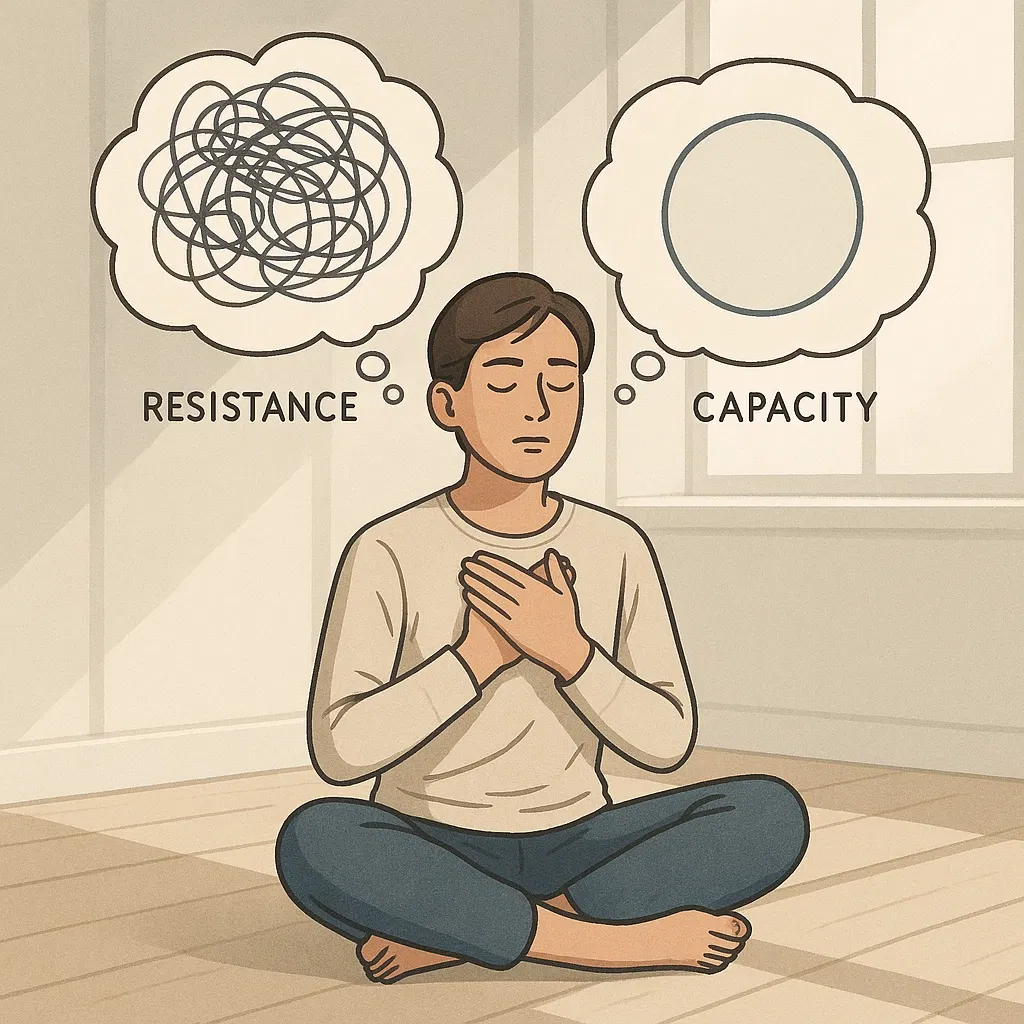
When you increase your capacity, you don’t react to the chaos. You hold space for it. You become the grounded wire that allows the electrical storm in your house to pass through without blowing any fuses.
Why Your Nervous System is the Remote Control for Your Kids
If you want to be a better parent, you have to realize that you are the emotional thermostat of the house. You don't just set the temperature; you are the temperature.
When your child is screaming because you cut their toast into triangles instead of squares, your first instinct is likely irritation. Your nervous system perceives their scream as a "threat." You go into fight-or-flight. You yell, you threaten a timeout, or you shut down.
Now, you have two dysregulated nervous systems screaming at each other. Nothing gets solved.

Co-regulation means that in that moment of toast-induced crisis, you notice your own heart racing. You breathe. You stay grounded. You don't try to "fix" the kid; you regulate yourself.
When you stay calm, your child’s nervous system eventually "downloads" your calm. This is how you raise resilient, emotionally intelligent children. You aren't just teaching them how to behave; you are literally training their brain how to return to a state of safety. For more on this, check out our guide on 4 steps to mindful parenting.
Healing Your Marriage Without a Single Therapy Session
Marriage is essentially two nervous systems living in a small box, trying not to set each other off.
Most marital conflict is just a feedback loop of dysregulation. Partner A feels neglected (dysregulated) -> Partner A attacks Partner B -> Partner B feels threatened (dysregulated) -> Partner B withdraws. Round and round it goes.
If you want to improve your relationships, someone has to break the loop.
When you work on your own regulation, you stop being a "trigger" for your spouse. When they come home stressed, instead of matching their energy and starting a fight, you remain the steady presence. You become a "safe harbor."

This isn't about being a doormat. It’s about being a leader. A regulated person is the most powerful person in the room because they aren't at the mercy of everyone else’s moods.
The Foundation of Growth: The 10-Minute Reset
You can’t think your way into a regulated nervous system. You can’t read enough books to make your body feel safe.
Regulation is a physiological skill. It’s like building a muscle. If you want to change the way you show up for your family, you have to train your system to handle more "charge" without breaking.

This is why we created the Nervous System Reset Protocol. It’s a 10-minute daily practice designed to move you out of "survival mode" and into a state of "creative flow."
When you regulate your own system, everything downstream changes:
- Your kids stop "triggering" you so easily.
- Your spouse feels safer opening up to you.
- You find yourself making better decisions at work because you aren't stuck in a stress loop.
How to Start Today
If you’re tired of the constant "static" in your home, the bickering, the exhaustion, the feeling that you’re always one step away from a blow-up, it’s time to look under the hood.
The chaos you see on the outside is just a reflection of the dysregulation on the inside.
1. Identify Your Survival Patterns.
We all have them. Some of us "people please" to keep the peace. Some of us "control" to feel safe. Some of us just "shut down." You can’t change what you don't see.
Download our free guide to Discover Your Survival Patterns and see how they are running your life.
2. Practice Self-Regulation First.
The next time your spouse says that "one thing" that usually starts a fight, stop. Don't speak. Feel the sensation in your body. Breathe. See if you can stay in your body for 90 seconds without reacting. That is the beginning of co-regulation.
3. Get the Support Your System Needs.
You weren't meant to do this alone. Remember, the limbic system is an open loop: it needs other regulated systems to learn.
If you’re ready to stop the cycle and lead your family into a new state of peace and connection, book a call with our team here.
Your family doesn't need a "perfect" version of you. They need a regulated version of you. They need you to be the one who can hold the space when they can’t.
Stop trying to fix them. Start regulating you. Watch how the world around you changes in response.