 Satori
You’ve done the work. You’ve read the books, attended the retreats, and sat on the therapist’s couch until you could recite your childhood trauma like a grocery list. You have the "insight." You know why you do what you do.
And yet, when the pressure hits or that one person says that one thing, your heart still races. Your throat still tightens. You still snap at your partner or dive headfirst into a bottle of wine or a 14-hour workday to escape the noise in your head.
Here’s the cold, hard truth: Insight doesn't change wiring.
Knowing you’re safe isn't the same as feeling safe. Your mindset is just the top floor of a skyscraper, but the foundation: your nervous system: is where the real decisions are being made. If the foundation is shaking, no amount of positive thinking is going to keep the building steady.
If you want to know how to heal myself, you have to stop looking at your thoughts and start looking at your biology. Welcome to the ultimate guide to nervous system health.
The Mindset Trap: Why Thinking Your Way Out Doesn’t Work
We’ve been sold a lie that "mindset is everything." While mindset work has its place, it’s fundamentally a "top-down" approach. You’re trying to use your prefrontal cortex: the logical, thinking part of your brain: to negotiate with your brainstem and limbic system: the primal parts responsible for your survival.
Imagine your house is on fire. The smoke is thick, the flames are licking the ceiling, and the fire alarm is screaming at 120 decibels. Mindset work is like standing in the middle of that room and trying to negotiate with the fire alarm.
"Actually, alarm, I am safe. I am abundant. This fire is just a limiting belief."
The alarm doesn't care. Its only job is to keep you alive, and right now, it senses a threat. To stop the alarm, you have to put out the fire. In your body, that "fire" is a dysregulated nervous system stuck in a survival loop.
The Biology of Regulation: Meet Your Autonomic Nervous System
To master nervous system regulation, you have to understand the hardware you’re running on. Your Autonomic Nervous System (ANS) is the silent conductor of your life. it controls your heart rate, digestion, immune response, and: most importantly: your state of being.
It has two primary branches:
- The Sympathetic Nervous System (The Gas): This is your fight-or-flight mode. It’s designed to mobilize energy so you can outrun a tiger (or a tight deadline). When it’s active, your heart rate goes up, your breath gets shallow, and your focus narrows.
- The Parasympathetic Nervous System (The Brake): This is your rest-and-digest mode. It’s where healing, connection, and creativity happen.
The problem isn't that we go into sympathetic mode. The problem is that we get stuck there.
The Third State: Freeze and Shutdown
When the threat feels too big to fight or flee, your system hits the emergency "kill switch." This is the dorsal vagal state, or "Freeze." You feel numb, foggy, unmotivated, or "checked out." Many people who think they are "lazy" are actually just stuck in a chronic freeze state because their nervous system is overwhelmed by the sheer volume of stress they’re carrying.
Healing isn't about avoiding these states; it's about building the flexibility to move in and out of them without getting trapped.
Why We Get Stuck: The Biology of Trauma
Trauma isn't just "something bad that happened." Trauma is a biological record of an incomplete survival response.
Think of a gazelle being chased by a lion. If the gazelle escapes, it will literally shake its entire body for several minutes. That shaking is the nervous system discharging the massive amount of "survival energy" it mobilized to run. Once the energy is discharged, the gazelle goes back to eating grass as if nothing happened.
Humans, however, have been socialized to suppress that discharge. We "keep it together." We "suck it up." We stay "professional."
As a result, that survival energy stays trapped in our tissues. Years later, we wonder why we have chronic back pain, digestive issues, or an anxiety disorder that won't quit. On a physiological level, your body still thinks the lion is behind you.
This is why we say: "Stop trying to make yourself feel better and simply get better at feeling."™

"Stop Trying to Feel Better": The Satori Prime Philosophy
Most personal development is about "fixing" emotions. You feel sad? Here’s a gratitude journal. You feel anxious? Here’s a breathing exercise to make it go away.
At Satori Prime, we take a different approach. When you try to "fix" a feeling, you’re sending a signal to your nervous system that the feeling is a threat. This creates a secondary layer of tension: you’re now stressed about being stressed.
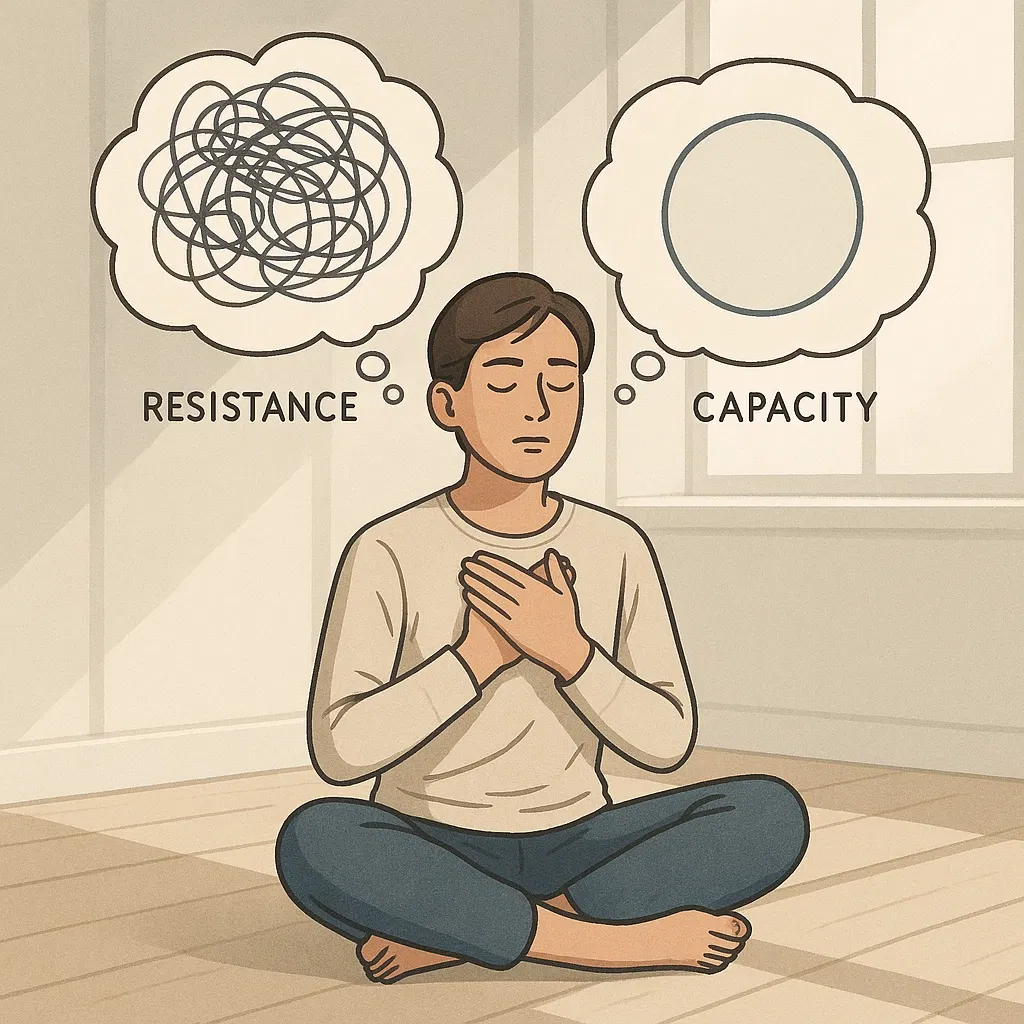
Getting better at feeling means expanding your "capacity." Imagine your emotional capacity as a container. If you have a small container, a little bit of anxiety overflows the cup and ruins your day. If you expand that container through nervous system health practices, that same amount of anxiety barely covers the bottom. The emotion hasn't changed, but you have.
When you stop resisting your internal experience, the "stuck" energy finally has permission to move. This is the secret to how to heal myself from the inside out.
The Nervous System Reset Protocol: Your 10-Minute Daily Practice
You don't need a 10-day silent retreat to start healing. You need a consistent, biological signal of safety. This is where our Nervous System Reset Protocol (NSRP) comes in.
The NSRP is a daily practice designed to retrain your nervous system to move from survival mode back into a state of "Social Engagement" (the safe and connected state). Unlike meditation, which often asks you to "clear your mind," NSRP focuses on:
- Somatic Tracking: Noticing the physical sensations in your body without judgment.
- Vagal Toning: Using specific movements and sounds to stimulate the vagus nerve.
- Pendulation: Gently moving your attention between a "resource" (a place that feels safe) and a place of tension, teaching your system that it can handle the "fire" without being consumed by it.
Just 10 minutes a day of this biological "re-wiring" can do more for your long-term health than a decade of traditional talk therapy.

Real Results: What Happens When You Regulate?
When you prioritize nervous system regulation, the "impossible" problems in your life start to dissolve.
- For High Performers: You stop oscillating between "Hustle" and "Burnout." You find a "flow state" that feels sustainable and grounded.
- In Relationships: You stop reacting from your "inner child's" fear and start responding from your "adult self's" presence. You can actually hear your partner instead of just preparing your defense.
- In Health: Your body finally has the resources it needs to repair itself. Chronic inflammation drops, sleep improves, and that "background hum" of anxiety finally goes quiet.
You are not broken. You are not stuck. You just have a nervous system that is doing exactly what it was trained to do: protect you. It’s time to give it a new set of instructions.
Your Path Forward
Healing is not a destination; it's a physiological shift. If you're tired of the "comfort addiction cycle" and you're ready to actually change the wiring underneath your thoughts, we're here to help.
1. Identify Your Patterns
The first step is seeing the "survival patterns" you're currently running. Whether it's people-pleasing, perfectionism, or chronic procrastination, these aren't personality flaws: they're survival strategies.
👉 Download our Free Survival Patterns Guide here.
2. Dive Deeper
If you've done the surface work and you're ready for the "root cause" transformation, let's talk. We work with high performers who are serious about long-term, sustainable change.
👉 Book a call with our team here to explore the Nervous System Reset Protocol.
3. Explore More
Want to keep learning about the science of transformation? Check out our latest insights on the Satori Prime Blog or learn about our upcoming summits.
Stop trying to think your way into a better life. Start feeling your way into a new biology. Your nervous system is waiting.