
Let’s be honest: most relationship advice is a total dumpster fire.
We’re told to "communicate better," "use I-statements," or "set boundaries" as if we’re robots programmed with logic. But here’s the reality: when your partner is screaming, your toddler is having a Level-10 meltdown, or your team at work is losing their minds, logic is the first thing that goes out the window.
Why? Because your nervous system has taken over the driver’s seat.
If you want to improve relationships, be a better parent, and be more peaceful in a world that feels like it’s constantly on fire, you don't need more "tips." You need to understand the biological invisible wire that connects us all.
Welcome to the ultimate guide to co-regulation. This isn't just about "getting along." It’s about the bio-physics of how you heal your world by regulating your own system first.
The Myth of Fixing Others
Most people approach their relationships like a high-stakes repair shop. You see your partner’s anxiety or your child’s defiance as a problem to be solved. You think, “If they would just stop being so [insert emotion], then I could finally feel at peace.”
But here’s the Satori Prime truth: Stop trying to make yourself feel better and simply get better at feeling.™
When you try to "fix" someone else's state, you are actually transmitting a signal of resistance. Your nervous system is saying, "Your current state is not safe for me." And guess what? They feel that. They feel your judgment, your fear, and your tension. They don't hear your words; they hear your frequency.
Co-regulation is the radical realization that your state is the most powerful tool you have. It is the process of two nervous systems influencing each other. If you are grounded, they have a place to land. If you are chaotic, you’re just adding fuel to the fire.

Part 1: The Science of Your Invisible Broadcast
Humans are social mammals. Our nervous systems aren't closed loops; they are open systems. We are constantly scanning the people around us to ask one question: "Am I safe?"
This is why, when you walk into a room where two people have just been fighting, you can "feel the tension." Your nervous system is picking up their "vibes": which is really just their heart rate variability, their muscle tension, and their respiratory rate.
In leadership and parenting, the person with the most stable nervous system always wins. Not "wins" as in defeating others, but "wins" the room by bringing everyone back to a state of safety.
If you want to have a successful relationship, you have to stop focusing on the words and start focusing on the field. When you regulate your own system, you literally provide a blueprint for others to do the same. This is the heart of co-regulation.
Part 2: Parenting as a Presence, Not a Project
We’ve all been there. Your kid is losing it because you cut the toast into triangles instead of squares. Your first instinct is to "parent" the behavior. You yell, you negotiate, or you threaten.
But a child’s nervous system is immature. They literally cannot self-regulate yet. They depend on your nervous system to act as a "borrowed" regulator.
If you want to be a better parent, you have to stop viewing the tantrum as a behavioral issue and start viewing it as a nervous system overload. When you stay calm, lower your voice, and stay present (even when they are screaming), you are co-regulating. You are showing their biology that the world isn't actually ending.
This is the path to mindful parenting. It’s not about being perfect; it’s about being the anchor. When you stop resisting their big feelings and simply get better at feeling the discomfort of their tantrum without needing to "fix" it, the tantrum dissolves faster.

Part 3: Leadership in the Eye of the Storm
In the corporate world, we talk about "emotional intelligence," but what we really mean is co-regulation.
Think about the best leader you’ve ever worked for. They probably didn't have all the answers, but they had a presence. When things went wrong, they didn't panic. Their nervous system stayed in the "green zone," and because of that, the whole team stayed productive.
Dysregulated leaders create dysregulated teams. If you lead from a place of stress, your team will subconsciously mirror that stress. Their brains will move into "survival mode," which shuts down the prefrontal cortex: the part of the brain responsible for creativity, problem-solving, and collaboration.
To succeed in leadership, you must first lead yourself. You must be the most regulated person in the room. When you stop chasing and start feeling, you become a magnet for talent and a source of stability for your organization.
Part 4: Getting Better at Feeling
Most of us spend our entire lives running away from "bad" feelings. We eat, drink, scroll, or work to avoid the discomfort of anxiety, anger, or sadness.
At Satori Prime, we teach a different way: "Stop trying to make yourself feel better and simply get better at feeling."™
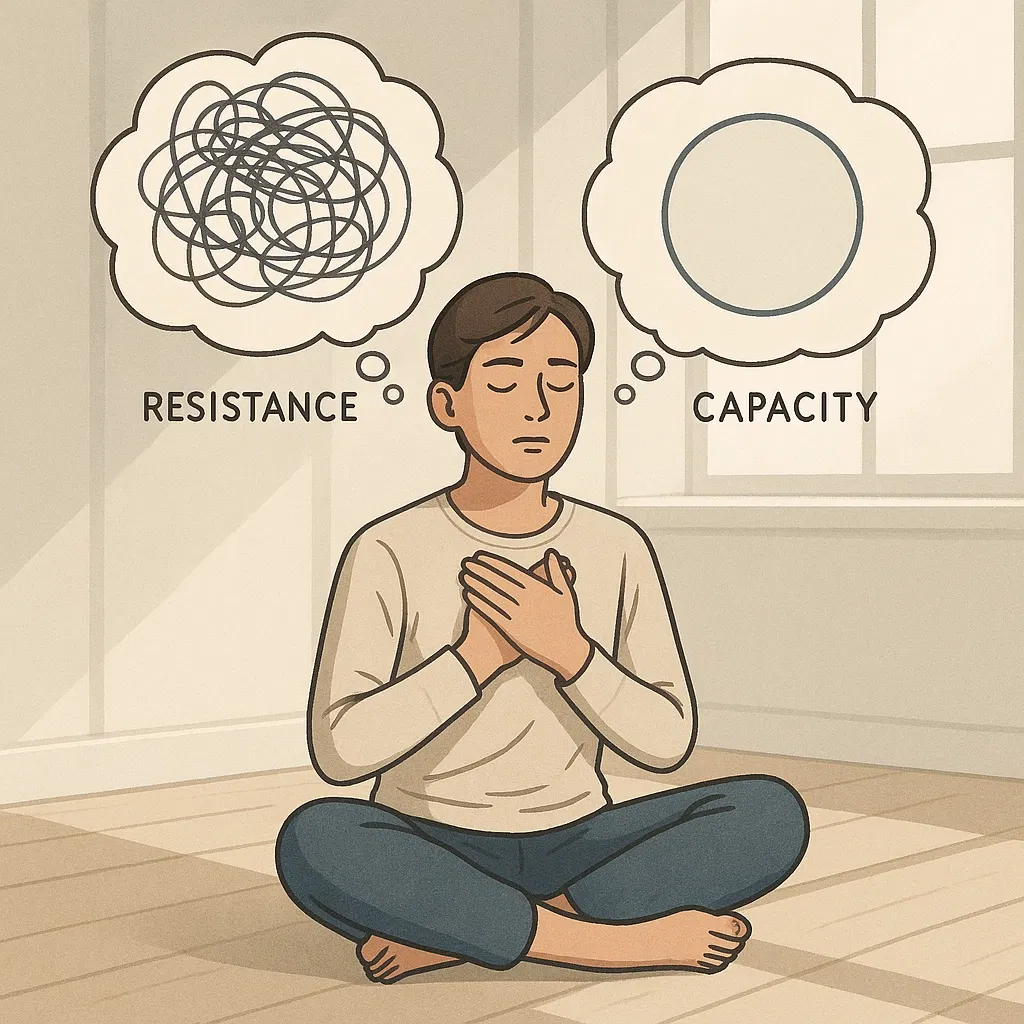
When you try to "feel better," you are creating a war inside yourself. You are telling a part of your experience that it shouldn't exist. This internal war keeps your nervous system in a state of high alert.
But when you get "better at feeling," you expand your capacity to hold whatever is coming up. You become a bigger container. And when your container is big enough, the "storms" of life don't knock you over.

Part 5: 3 Practical Steps to Master Co-regulation
Ready to change the energy in your home or office? Here is how you start:
1. The 10-Second Pause
When you feel the heat rising in your chest: that urge to snap at your spouse or bark at your employee: STOP. This is your nervous system moving into a survival pattern. Take 10 seconds to feel your feet on the floor. Don't try to change the feeling; just notice it.
2. Match the Volume, Lower the Intensity
In co-regulation, if someone is shouting and you whisper, it can feel dismissive. Sometimes you need to match their energy level but with a regulated tone. "I see you are incredibly frustrated right now!" said with a steady, grounded voice, tells their system you are present and safe, not a threat.
3. Expand Your Capacity
The only reason you get triggered by others is because they are poking a place in you that you haven't learned to "feel" yet. Use our Nervous System Reset Protocol to daily expand your capacity. When your baseline is "peaceful," the chaos of others becomes something you observe, not something you absorb.
Conclusion: The Path to Relationship Alignment
You cannot control other people. You can’t force your partner to be more affectionate, your kids to be more obedient, or your employees to be more motivated.
But you can change the energetic field they live in.
Co-regulation is the ultimate "cheat code" for life. When you master your own nervous system, you become the sun that others naturally orbit. You stop being a victim of other people’s moods and start being the architect of your own peace.
If you’re tired of the same old patterns and you’re ready to actually transform your life from the inside out, it’s time to stop talking and start feeling.
Ready to stop surviving and start thriving?
Download our free guide to Discover Your Survival Patterns and see exactly what's holding your nervous system back.
Want to go deeper?
If you're a high-performer ready for radical relationship alignment and leadership mastery, book your call with us today. Let's see if our Nervous System Reset Protocol is the missing piece of your puzzle.