 Satori
You don't need to be a mystic or mathematician to tap into the transformative power of sacred geometry. These ancient patterns: from spirals and circles to complex mandalas: aren't just beautiful art pieces collecting dust on your wall. They're practical tools that can rewire your nervous system, deepen your focus, and unlock profound personal growth.
And here's the thing: even if you're rolling your eyes at the word "sacred," stick with me. Because whether you see these patterns as divine blueprints or simply elegant visual aids, the science of how they affect your brain and body is pretty damn compelling.
The Secret Language of Shapes
Sacred geometry is based on the idea that specific patterns and ratios appear everywhere in nature: from the spiral of a nautilus shell to the hexagonal structure of honeycomb cells. These aren't random designs; they're mathematical relationships that create harmony, balance, and what researchers call "visual coherence."
Your brain is hardwired to recognize these patterns. When you look at a perfectly symmetrical mandala or trace the curves of a Fibonacci spiral, your nervous system naturally starts to regulate. It's like giving your mind a visual anchor in a world that's constantly pulling your attention in a thousand different directions.
The ancients understood this intuitively. They built temples using golden ratio proportions, created mandalas for meditation, and used geometric symbols as tools for transformation. They weren't just being artsy: they were hacking human consciousness.
Practical Sacred Geometry Rituals That Actually Work

Let's get real about how to use this stuff in your daily life. Forget about needing special crystals or spending hours in lotus position. Here are some accessible ways to integrate sacred geometry into your routine:
Morning Focus Ritual
Start your day by gazing at a geometric pattern for just 2-3 minutes while you drink your coffee. This could be as simple as looking at a mandala app on your phone or keeping a sacred geometry art print on your desk. The key is letting your eyes trace the patterns without forcing anything. Notice how your breathing naturally slows down and your mental chatter starts to quiet.
The Spiral Walk
When you're feeling overwhelmed or stuck in your head, try walking in a spiral pattern. You can do this in your backyard, at the park, or even in your office if you don't mind getting some looks. Start small and gradually expand outward, then reverse and spiral back to center. This simple movement pattern helps reset your nervous system and can unlock creative solutions to problems you've been wrestling with.
Geometry Journaling
Before writing in your journal, draw a simple geometric shape at the top of the page: a circle, triangle, or star. Let that shape inform what you write about. A circle might inspire reflections on wholeness or completion. A triangle could spark thoughts about balance or the three key areas you want to focus on. This isn't woo-woo nonsense; it's giving your subconscious mind a visual prompt to work with.
The Mandala Method: Meditation for Your Hands
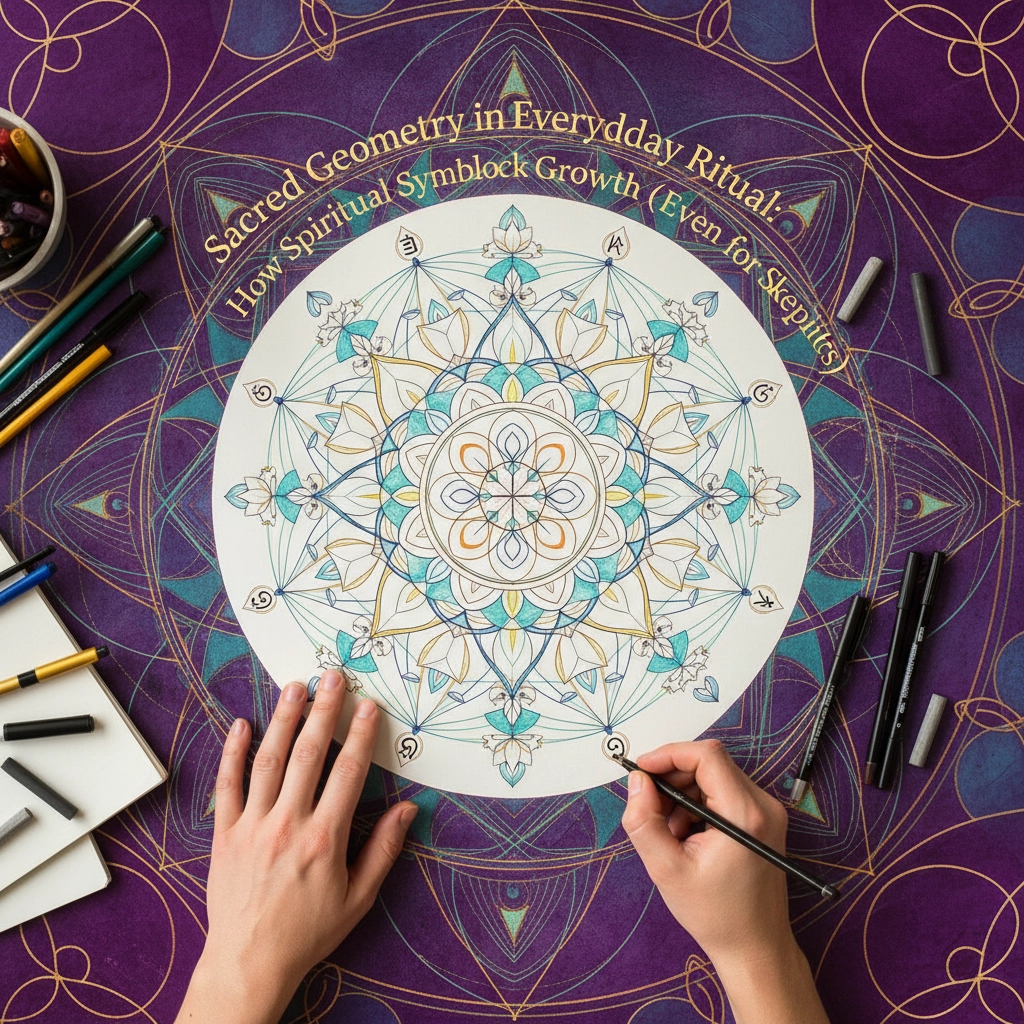
Creating mandalas is probably the most accessible entry point into sacred geometry practice. You don't need artistic skill: just a willingness to let your hands move while your mind settles.
Start with a simple circle drawn on paper. From there, add shapes, lines, and patterns radiating outward from the center. There's no right or wrong way to do this. Some days your mandala might be geometric and precise. Other days it could be flowing and organic. The magic happens in the process, not the end result.
Research shows that the act of creating repetitive patterns activates the same parts of your brain that meditation does. You're literally rewiring neural pathways associated with calm focus and creative problem-solving. Plus, you end up with something beautiful to look at later.
For the Skeptics: The Science Behind the Symbols
Look, I get it. The spiritual language around sacred geometry can be off-putting if you prefer your personal development with a side of evidence. But here's what we know from neuroscience research:
Pattern Recognition and Calm
Your brain's pattern recognition system evolved to help you survive. When it encounters harmonious, symmetrical patterns, it signals safety to your nervous system. This is why looking at mandalas or fractals can instantly reduce stress and anxiety: your ancient wiring interprets these patterns as "all is well."
Flow State Activation
The process of creating or contemplating geometric patterns can trigger flow states: those moments of effortless focus where time seems to disappear. Flow states are associated with increased creativity, better problem-solving, and enhanced well-being. Sacred geometry practices are essentially flow state induction techniques disguised as spiritual practices.
Bilateral Brain Integration
Many sacred geometry practices involve both logical, mathematical thinking (left brain) and creative, intuitive processing (right brain). This bilateral integration can lead to breakthrough insights and more balanced decision-making in your daily life.
Integrating Geometry Into Your Environment
You don't have to redecorate your entire house, but small environmental tweaks can have a big impact on your daily state of mind:
Workspace Sacred Geometry
Place geometric artwork where you'll see it during stressful moments: near your computer monitor, on your desk, or as your phone wallpaper. When you notice tension building, take 30 seconds to trace the patterns with your eyes. It's like having a reset button for your nervous system.
Ritual Space Design
Create a small area in your home arranged according to geometric principles. This might mean placing objects in triangular formations, arranging books in a spiral pattern, or simply having a mandala as a focal point. This isn't about perfection: it's about creating visual cues that remind your brain to drop into a more centered state.
Movement and Geometry
Incorporate geometric patterns into your exercise routine. This could mean doing yoga poses that form triangles and circles, arranging your workout equipment in specific patterns, or simply being more conscious of the geometric shapes your body creates during movement.
The Daily Sacred Geometry Practice
Here's a simple 5-minute morning practice that combines several elements:
-
Breathe into a shape (1 minute): Visualize breathing into a triangle, square, or circle. Let each inhale fill the shape, each exhale soften its edges.
-
Pattern tracing (2 minutes): Use your finger to trace geometric patterns in the air, on your desk, or on your body. Start with simple circles and spirals, then experiment with more complex shapes.
-
Geometric intention setting (2 minutes): Choose a shape that represents what you want to cultivate today. A circle for wholeness, a triangle for balance, a spiral for growth. Hold this image in your mind as you set your intention for the day.
The beauty of sacred geometry practices is their accessibility. You don't need special equipment, years of training, or even belief in their mystical properties. You just need curiosity and a willingness to experiment with ancient patterns that have been supporting human consciousness for thousands of years.
Whether you approach this as a spiritual practice, a neuroscience hack, or simply a creative outlet, the patterns themselves will do their work. Because at the end of the day, sacred geometry isn't about the symbols: it's about returning to the natural harmony that's already within you.