
You’ve done the work. You’ve read the books, attended the seminars, and filled journals with affirmations. You’ve built the career, hit the milestones, and maybe even secured the bag.
But be honest: Does it actually feel like you thought it would?
Most high-performing leaders are running on a treadmill of "prove mode." You hit a goal, feel a momentary spike of relief, and immediately start looking for the next mountain to climb because the quiet moments feel… dangerous. Rest feels like laziness. Uncertainty feels like a threat.
Here’s the secret the "hustle culture" gurus won't tell you: Your mindset isn't the problem. Your nervous system is.
If you want to access consistent flow states, scale your income, and lead with a presence that commands a room, you have to stop trying to "think" your way there and start regulating your way there.
The Biology of Flow: It’s Not a Mindset, It’s a State
We talk about "flow" like it’s a magical gift from the universe. In reality, flow is a specific physiological state. It’s the "regulated middle" of your nervous system.
When you’re in a flow state, your brain’s self-criticism shuts down, your pattern recognition spikes, and time seems to dilate. But you can’t get there if your body thinks it’s being chased by a saber-toothed tiger.
Most entrepreneurs operate in a state of chronic sympathetic activation: fight or flight. When you’re in fight or flight, your body prioritizes survival over creativity. You become reactive, short-tempered, and narrow-minded. You might get things done, but you’re burning out your engine to do it.
On the flip side, if the pressure gets too high, you might slip into "functional freeze": that state where you’re staring at your screen for hours, doing busy work, but actually accomplishing nothing.
Flow happens in the Window of Tolerance. It’s that sweet spot where you are alert but calm, challenged but safe.
Money Biology: Why Your Bank Account Has a Ceiling
You want to make more money. You’ve tried the "money mindset" shifts. You’ve visualized the millions. So why are you still hitting the same financial glass ceiling?
Because your nervous system has a "wealth set point."
Every level of success brings a new level of "threat." More money means more responsibility, more visibility, and more to lose. If your nervous system perceives that level of expansion as a threat to your safety, it will subconsciously sabotage you to keep you small and "safe."
How many times have you had a record-breaking month only to immediately face an unexpected "emergency" that drains your accounts? Or perhaps you land a massive contract and suddenly find yourself paralyzed by impostor syndrome?
That’s not a lack of talent. That’s your nervous system trying to pull you back into your comfort zone.
To make more money, you don't just need a better strategy; you need a larger "container." You have to increase your nervous system's capacity to hold the sensation of having, managing, and keeping wealth.
Want to know what's really running the show? Take our Free Survival Patterns Guide to see how your biology is blocking your bank account.
The Achiever’s Trap: Why Mindset Work Hits a Wall
We’ve all been there: You're at a high-intensity weekend event. You're pumped, you're crying, you're shouting your goals. You feel like a new person. Then, Tuesday hits. You’re back at your desk, and that old familiar anxiety is right there waiting for you.
Why? Because your nervous system doesn't speak the language of thought.
You can tell yourself "I am safe" a thousand times, but if your heart is racing and your gut is tight, your body doesn't believe you. Your nervous system speaks the language of sensation, threat, and safety.
At Satori Prime, we call this the Achiever’s Trap. You try to use your mind to control your body. It’s like trying to fix a computer’s hardware by rewriting the software. If the motherboard is fried, the new code won't run.
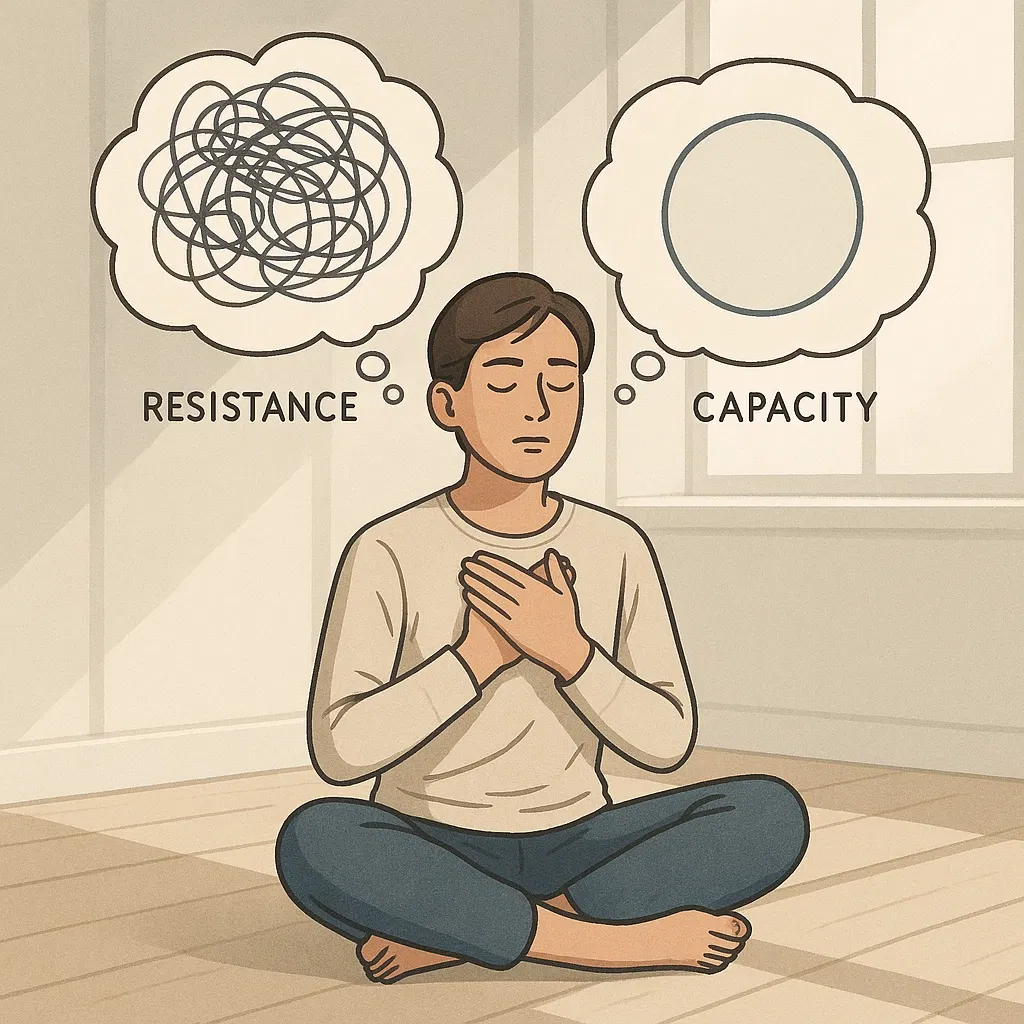
"Stop Trying to Feel Better: Get Better at Feeling"™
This is the core of everything we do.
Most personal development is about "feeling better." We want to get rid of the anxiety, delete the fear, and crush the doubt. But the more you resist a feeling, the more power it has over you.
When you try to "fix" a feeling, you’re telling your nervous system that the feeling is a threat. This creates a loop:
- You feel anxiety.
- You judge the anxiety as "bad."
- Your body perceives that judgment as a new threat.
- You feel more anxiety.
The shift happens when you get better at feeling.
Getting better at feeling means expanding your capacity to sit with the discomfort of growth without needing to fix it, numb it, or run away from it. When you can feel the "heat" of a $100k negotiation without your system going into a meltdown, you win. When you can handle the "sting" of a public failure without losing your sense of self, you become unfuckwithable.
Leadership in the Age of Regulation
High-performing leaders don't just manage teams; they manage the energy of the room. This is called co-regulation.
If a CEO walks into a board meeting with a frazzled, dysregulated nervous system, everyone in that room will unconsciously pick up on that stress. Productivity drops, creativity stalls, and the team moves into survival mode.
But a leader who is grounded and regulated creates a "field" of safety. In that safety, employees take risks, they innovate, and they perform at their highest level.
Regulated leadership is the ultimate competitive advantage. It’s the difference between a team that works out of fear and a team that works out of flow.

How to Start Regulating for High Performance
You don't need a month in a Himalayan cave to rewire your system. You need consistent, daily practice. Here’s how to start:
- Check Your Arousal Levels: Throughout the day, ask yourself: "Where am I on the scale?" Are you too "hot" (anxious, racing) or too "cold" (numb, procrastinating)?
- The 10-Second Orient: If you feel a spike of stress, stop. Look around the room. Find three things that are blue. Feel your feet on the floor. This simple act tells your brain: I am here, and I am safe.
- Lengthen Your Exhale: A long, slow exhale (longer than your inhale) is a direct hack for your vagus nerve. It flips the switch from "fight" to "flow."
- Stop the Fix-It Loop: The next time you feel a "negative" emotion, don't try to change it. Just name it. "I’m noticing a tightness in my chest." Stay with it for 60 seconds. Watch what happens.
Your Next Level is a Physiological Shift
If you’re ready to stop grinding and start flowing, it’s time to look under the hood. You don't need more "hustle." You need more capacity.
The most successful people on the planet aren't the ones who work the hardest; they’re the ones who can stay regulated under the highest amounts of pressure. They have a nervous system that can hold the weight of their vision.
Are you ready to stop trying to feel better and start getting better at feeling?
Let’s get your biology on board with your ambition.
Book a Strategy Call with Our Team Here to see how we can help you regulate your way to the next level.