 Satori
If I hear one more person tell me to "just change your mindset" or "visualize your way to a million dollars," I might actually lose it.
Don't get me wrong. I’m all for intention. I’m all for growth. But we have to stop pretending that the brain is the only player in the game. You’ve spent thousands on seminars, you’ve read every book on the shelf, and you’ve plastered your mirror with affirmations that you honestly don’t even believe. Yet, when the high-stakes meeting starts or the big investment opportunity lands on your desk, your throat tightens, your palms sweat, and you find yourself playing small. Again.
Here’s the cold, hard truth: Your body is the gatekeeper of your success, not your thoughts.
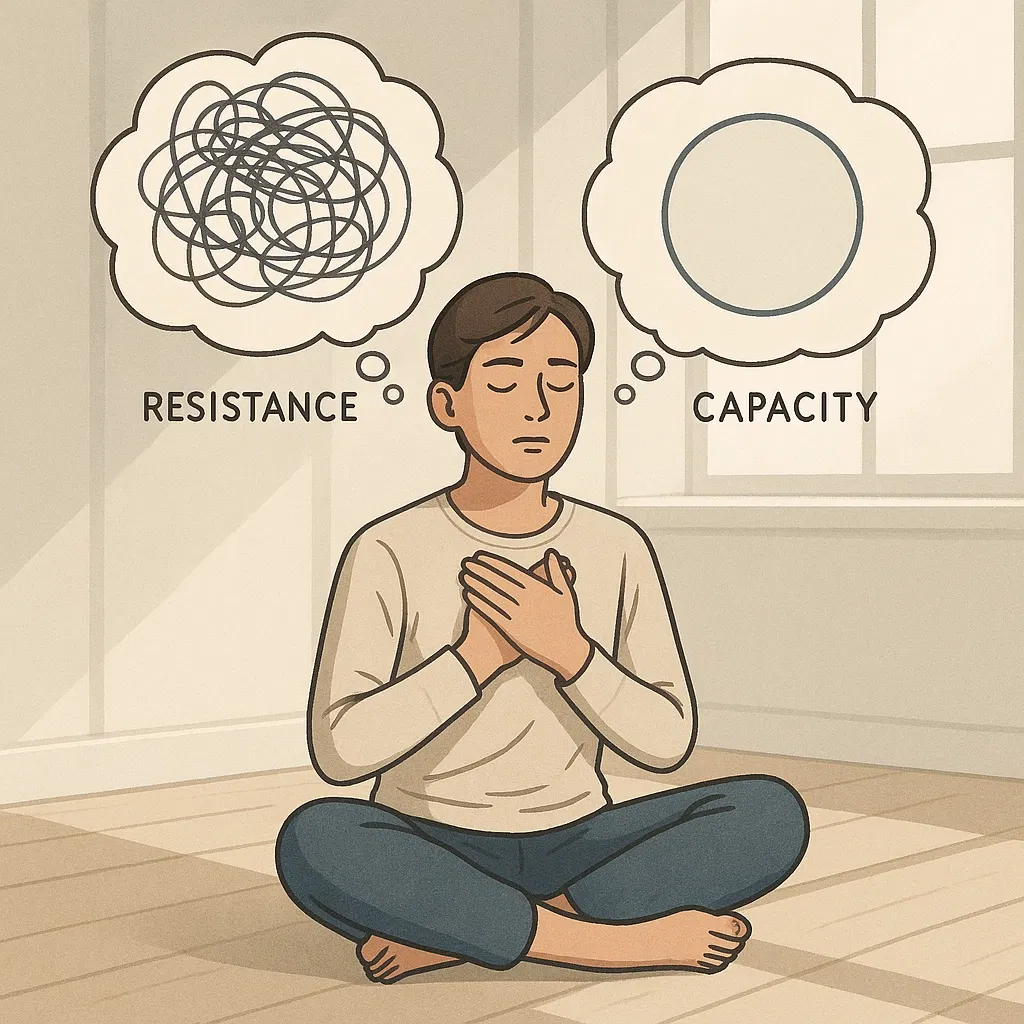
While you’re busy trying to "reprogram" your mind, your nervous system is running a program that was written before you could even speak. If your body doesn't feel safe with the level of success you’re chasing, it will sabotage you every single time. It’s not a mindset problem; it’s a capacity problem.
The Great Mindset Lie
For decades, the personal development industry has sold us a "top-down" approach. The idea is simple: change your thoughts, change your life. But have you ever noticed how how mindset affects success seems to hit a ceiling?
You can tell yourself "I am worthy" ten thousand times, but if your nervous system is stuck in a "freeze" state from a childhood trauma or a past business failure, those words are just noise. Your biology will always trump your psychology. Think of your mind as the software and your body as the hardware. You can’t run a 2026 high-performance operating system on hardware that’s still stuck in 1998 "survival mode."

Why Your Nervous System Is the Real CEO
When we talk about high-stakes leadership, we aren't talking about who has the best strategy. We’re talking about who has the most regulated nervous system.
In a crisis, a leader who is "all in their head" becomes frantic. They over-analyze, they hesitate, or they snap. But a leader who has mastered their nervous system can sit in the fire and feel cool. This isn't some "woo-woo" concept; it’s pure physiology. When you are regulated, you have access to your prefrontal cortex: the part of the brain responsible for logic, creativity, and long-term planning. When you’re dysregulated (even if you’re masking it with a "positive mindset"), you’re operating from your reptilian brain. You are literally incapable of making visionary decisions in that state.
This is why many high achievers hit a plateau. They’ve "hustled" their way to a certain level, but their body is exhausted. They are living in a constant state of high-beta brain waves, and their wealth capacity has hit a biological limit. They can't hold more money, more responsibility, or more impact because their system is already at its breaking point.
The Biology of Wealth Capacity
Have you ever wondered why some people seem to attract money effortlessly while others struggle for every cent? It’s rarely about who works harder. It’s about who can hold the energy of wealth.
Wealth is a frequency, but more importantly, it's a physical sensation. For many of us, "more" feels like "danger." More money means more people wanting something from us. More visibility means more potential for criticism. If your nervous system associates being seen or being powerful with being "unsafe," it will trigger a physical contraction.
You’ll find ways to "leak" the money. You’ll miss the deadline. You’ll pick a fight with your business partner. To expand your wealth, you must first expand your nervous system’s capacity to feel safe while holding more.
Anti-Mindset Philosophy: Moving from Thinking to Being
At Satori Prime, we practice an anti-mindset philosophy. We aren't interested in adding more "thoughts" to your already cluttered brain. We’re interested in helping you stop chasing and start feeling.
Transformation doesn't happen when you understand a concept intellectually. It happens when your body relaxes into a new reality. This is the difference between knowing you’re a leader and embodying leadership. When you embody it, you don't need affirmations. You don't need to "psych yourself up." You just are.
This shift requires moving into the realm of the subconscious. As experts like Dr. Bruce Lipton have shown, our subconscious mind: which is deeply tied to our bodily sensations: controls 95% of our lives. If you want to change the 95%, you have to go where the 95% lives: in the tissues, the breath, and the nervous system.
Parenting and the Generational Loop
This isn't just about your business; it’s about your legacy. We talk a lot about prenatal imprinting and how a parent's nervous system state actually shapes the biology of their child.
If you are a parent trying to "teach" your kids about confidence while you are secretly vibrating with anxiety, they won't learn your words. They will mirror your state. Your children are "biological mirrors." The greatest gift you can give them isn't a college fund; it's a regulated parent. When you do the work to clear your own bodily blocks, you stop passing that "survival" biology down the line. You break the cycle of generational trauma not by talking about it, but by physically shifting your way of being.

Stop Managing Symptoms, Start Rewiring the System
Most coaching focuses on symptom management. "Are you procrastinating? Here’s a time-management hack." "Are you afraid of public speaking? Here’s a breathing exercise."
That’s like trying to fix a sinking ship by bucket-brigading the water out instead of plugging the hole. The "hole" is a nervous system that is misinterpreting growth as a threat.
When you learn Nervous System Mastery, you stop fighting yourself. You stop the internal tug-of-war where one part of you wants to soar and the other part is slamming on the brakes. You start to navigate high-stakes environments with a sense of play rather than a sense of peril.
Imagine being able to walk into a room of investors and feel the same level of calm as you do sitting in your living room. Imagine being able to scale your business to 7 or 8 figures without the burnout because your "internal container" has actually grown to hold that weight.

The Path Forward: Embodied Excellence
It’s time to retire the "grind" and the "mindset hacks." They served you to a point, but they won't take you where you’re going. The next level of your evolution is biological. It’s visionary. It’s about becoming a person who can stay grounded when the world is shaking.
You don't need more information. You need a different experience of being alive. You need to teach your body that it is safe to be powerful, safe to be seen, and safe to be wealthy.
If you’re ready to stop the endless loop of "doing" and finally step into the power of "being," we have something for you. We’ve spent years refining a protocol that bypasses the noisy mind and goes straight to the source: your nervous system.
This isn't another course you'll leave half-finished. This is a visceral transformation.
⚡ Ready to Stop Sabotaging Your Success? ⚡
Your body has been trying to protect you, but it’s time to tell it that the "danger" is over and the "adventure" has begun.
Join our Nervous System Mastery program and learn how to expand your capacity for leadership, wealth, and impact from the inside out. Stop letting your biology dictate your ceiling.
SPECIAL OFFER: Because you’re reading this today, you can get started with a 50% DISCOUNT.
👉 Claim Your 50% Discount on Nervous System Mastery Now!
It’s time to come home to yourself. It’s time to let your body support your vision rather than blocking it. Let’s get to work.