
Let’s be real for a second: you’ve probably spent thousands of dollars and hundreds of hours trying to "fix" your mindset. You’ve read the books, you’ve done the affirmations, you’ve journaled until your hand cramped, and you’ve tried to "positive think" your way out of anxiety, burnout, or that heavy feeling in your chest that just won't go away.
And yet, here you are. Still feeling like you’re running on a treadmill that’s going just a little too fast. Still snapping at your partner for no reason. Still feeling that familiar "tightness" when a work email hits your inbox.
Here’s the punchline: Your mindset isn't the problem. Your physiology is.
At Satori Prime, we’ve spent years helping high performers and leaders realize that trying to fix your life with "mindset work" is like trying to rewrite the software of a computer while the hardware is literally on fire. You can’t think your way out of a survival response.
If you want to truly heal, you have to stop focusing on your thoughts and start focusing on your biology. This is the ultimate guide to nervous system health and why regulating your biology is the only way to finally feel like yourself again.
The Biology of Why You’re Stuck
To understand how to heal, you have to understand the "hardware" you’re operating with. Your Autonomic Nervous System (ANS) is the behind-the-scenes operator of your entire life. It controls your heart rate, your digestion, your hormones, and, most importantly, how you perceive the world.
Your ANS has two primary gears:
- The Sympathetic Nervous System (SNS): This is your accelerator. It’s the "Fight or Flight" mode. When it’s active, your body is mobilized for threat. Your heart rate climbs, your pupils dilate, and your blood flows away from your vital organs and into your limbs so you can run or fight.
- The Parasympathetic Nervous System (PNS): This is your brake. It’s the "Rest and Digest" (or "Social Engagement") mode. This is where healing, repair, and deep connection happen.
In a healthy system, you oscillate between these two naturally. You get stressed (SNS), the stressor ends, and you return to baseline (PNS).
The problem? Most of us are stuck. Due to past trauma, chronic stress, or the sheer velocity of modern life, our "accelerator" is jammed to the floor. Or, even worse, we’ve burnt out so hard that our system has hit the "emergency brake," leaving us in a state of "Freeze" or "Shutdown" (what we call the dorsal vagal response).
Why Mindset Work Isn't Enough
We’ve been sold a lie that if we just change our thoughts, our lives will change. While mindset is important, it’s a top-down approach. It starts in the prefrontal cortex, the thinking brain.
The issue is that when your nervous system is dysregulated, your thinking brain literally goes offline. When you’re in a "Fight or Flight" or "Freeze" state, the survival parts of your brain (the amygdala and brainstem) take over. They don't care about your affirmations. They don't care about your "gratitude list." They care about surviving a perceived threat.
This is why you can know logically that you’re safe, but still feel like you’re dying during a panic attack.
To truly heal, we need a bottom-up approach. We need to talk to the body in its own language, the language of sensation, breath, and movement, to signal to the brain that the war is over.
"Stop Trying to Make Yourself Feel Better…"
Our core philosophy at Satori Prime is simple but radical: "Stop trying to make yourself feel better and simply get better at feeling."™
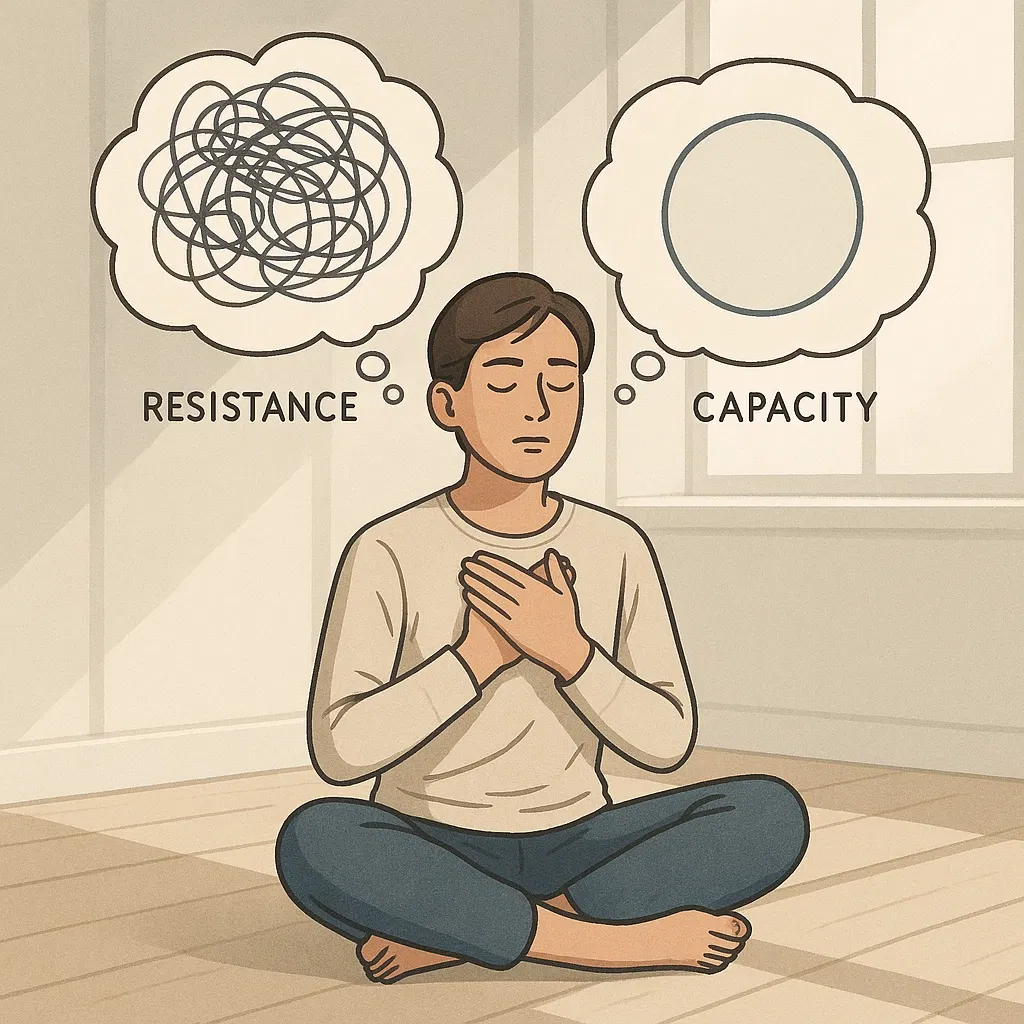
Most people approach "healing" as an attempt to delete "bad" feelings. They want to get rid of the anxiety, the sadness, or the anger. But those feelings are just signals from your nervous system. When you try to "fix" or suppress them, you create internal resistance. Resistance is what keeps you stuck.
When you "get better at feeling," you expand your Window of Tolerance. You develop the capacity to hold intense sensations without being overwhelmed by them. Healing isn't the absence of stress; it's the ability to process stress through your body without it becoming "stuck" as trauma.
If you’re wondering what your own "stuck" patterns look like, you can grab our free guide on common survival patterns here. It’ll help you identify if you’re stuck in Fight, Flight, Freeze, or Fawn.
Healing Trauma: The Somatic Secret
Trauma isn't what happened to you; it’s what happens inside of you as a result of what happened. Biologically speaking, trauma is "incomplete survival energy."
When something overwhelming happens and you can't fight back or run away, that massive surge of energy gets trapped in your tissues. Years later, a simple work deadline or a comment from a spouse can trigger that trapped energy, making you react as if you’re back in the original traumatic event.
Healing "how to heal myself" isn't about re-traumatizing yourself by talking about the past over and over. It’s about teaching your nervous system how to discharge that old energy and return to a state of safety.

The Nervous System Reset Protocol
Because we know you don’t have four hours a day to meditate on a mountain, we developed the Nervous System Reset Protocol. It’s a 10-minute daily practice designed for high-performers who need real results in real time.
This isn't just "relaxing." It’s a targeted sequence that uses:
- Vagal Toning: Stimulating the Vagus nerve (the superhighway of your parasympathetic system) to flip the switch from stress to safety.
- Somatic Tracking: Learning to observe sensations in the body without judgment.
- Breath Mechanics: Using specific respiratory patterns to shift blood chemistry and heart rate variability (HRV).
By doing this for just 10 minutes a day, you begin to rewire your baseline. You stop being a "stress-seeking missile" and start becoming a grounded, present leader. You start to notice that you have more "space" between a trigger and your reaction. That space is where your freedom lives.
What Real Regulation Looks Like
A regulated nervous system doesn't mean you’re a Zen monk who never gets angry. It means you’re resilient.
When you have a healthy, regulated system:
- You can feel anger without burning your life down.
- You can feel fear without being paralyzed.
- You can work hard without burning out.
- You can be deeply intimate because your body finally feels safe enough to open up.
You become like the woman in the greenhouse, grounded, growing, and vibrant, even if the world outside is chaotic.

Your Path Forward
If you’ve spent your life trying to "mindset" your way to happiness and it hasn't worked, it’s time to try something different. It’s time to look at the biology.
The journey to nervous system health is the most important work you will ever do. It is the foundation for your financial success, your physical health, and the quality of your relationships. Without a regulated system, everything else is just a temporary band-aid.
Are you ready to stop "fixing" yourself and start healing?
- Step 1: Identify your patterns. Download our Free Survival Patterns Guide to see exactly how your nervous system is currently trying to protect you (and how it’s holding you back).
- Step 2: Get expert eyes on your system. If you’re a high-performing leader who is tired of feeling "on" all the time, let’s talk. Book a call with our team here to see if our Nervous System Reset Protocol is the right fit for you.
Stop trying to feel better. Get better at feeling. Your body is waiting for you to come home.
Frequently Asked Questions
What is nervous system regulation?
Nervous system regulation is the ability of your autonomic nervous system to move flexibly between states of activation (stress) and states of rest and repair, returning to a baseline of safety once a threat has passed.
How do I know if my nervous system is dysregulated?
Common signs include chronic anxiety, "brain fog," digestive issues, sleep problems, feeling "tired but wired," emotional volatility, or a feeling of being disconnected from your body (dissociation).
Is this the same as meditation?
No. While meditation can be helpful, many people with dysregulated systems find traditional meditation difficult or even triggering. Nervous system regulation uses specific somatic (body-based) techniques to shift your physiology directly.
How long does it take to see results?
While deep healing takes time, many of our clients report a noticeable shift in their internal "tightness" and clarity within the first few days of using the Nervous System Reset Protocol.