
You’re sitting across from the person you love, but it feels like you’re staring through a kaleidoscope of jagged glass. Their voice: the one that used to be your favorite song: now sounds like nails on a chalkboard. You’re snapping at the kids for the crime of being children. You’re picking a fight over a dirty dish that, in any other reality, wouldn't even register on your radar.
Here is the truth you won't hear in a standard therapy session: It’s not a communication problem. It’s a nervous system problem.
When your internal wiring is fried, your reality becomes distorted. You aren't seeing your partner; you’re seeing your own projected static. You aren't parenting your children; you’re reacting to the sensory overload they represent. You are living in a state of survival, and you cannot build a visionary life or a peaceful home from a place of "fight or flight."
At Satori Prime, we live by a singular, transformative philosophy: "Stop trying to make yourself feel better and simply get better at feeling."™
If you want to improve relationships and be a better parent, you have to stop trying to "fix" the people around you and start recalibrating the instrument you use to perceive them: Your nervous system.
Here are the 7 relationship mistakes you’re making because your system is frazzled: and exactly how to shift the frequency.
1. The Scapegoat Effect: Making Your Partner the Problem
When your nervous system is overtaxed, your brain desperately seeks a reason for the discomfort. Since the "threat" is internal (cortisol, adrenaline, exhaustion), your mind scans the environment for an external target. Most of the time, that target is your partner.
You convince yourself that if they just changed their tone, did more chores, or understood you better, you’d finally be at peace. This is a lie. You are attempting to solve an internal energetic crisis with an external tactical solution. It never works.
2. The "Fix-It" Reflex (Avoiding the Raw Sensation)
Most of us are addicted to "making it better." When conflict arises, your frazzled system treats the emotional discomfort as a life-threatening emergency. You rush to apologize, demand an explanation, or force a resolution just so the "bad feeling" goes away.
By rushing to fix, you bypass the healing. You aren't actually resolving the issue; you’re just trying to numb the vibration of the conflict. Real alignment requires the capacity to sit in the fire without trying to put it out prematurely.
 ]
]
(Visual Description: A psychedelic, abstract representation of a human heart glowing with vibrant, pulsing neon colors, surrounded by swirling patterns of dark smoke that are beginning to dissolve into light, symbolizing the transition from internal chaos to radiant clarity.)
3. Reactive Parenting: Managing Their Noise to Mute Yours
To be more peaceful as a parent, you must realize that your children are often just mirrors of your own dysregulation. When your system is frazzled, your kids’ normal developmental behaviors: crying, playing loudly, asking "why": become triggers.
You find yourself shushing them, not because they are being "bad," but because you have zero capacity left to process sensory input. You are essentially asking your children to regulate your system for you. This is the opposite of the leadership they need.
4. The Tangle of Co-dysregulation
We are biological mirrors. If you walk into a room vibrating at the frequency of "I’m about to snap," your partner’s nervous system will unconsciously pick that up and match it. Before a single word is spoken, you’ve already started a war.
Co-regulation is the superpower of elite relationships. It’s the ability to stay grounded and expansive even when the other person is spiraling. But if your system is frazzled, you don't co-regulate; you co-dysregulate. You feed each other's fires until the house burns down.
 ]
]
(Visual Description: A stylized, visionary depiction of two people sitting back-to-back, their nervous systems glowing like golden roots that extend into the earth, grounding them amidst a storm of swirling, abstract geometric shapes in the background.)
5. The "Dorsal" Void: Stonewalling as Survival
Sometimes, being "frazzled" doesn't look like a panic attack or a scream. It looks like a total shutdown. This is the "Dorsal Vagal" response. You go numb. You stare at your phone. You give the silent treatment.
You think you’re just "giving it space," but you’re actually abandoning the connection because your system has literally run out of the energy required to engage. This leaves your partner feeling isolated and "crazy," which further destabilizes the relationship.
6. Hyper-vigilance: Mistaking Safety for Threat
When your system is stuck in a high-alert state, your "neuroception": your subconscious ability to detect safety: is broken. You start hearing a "tone" that isn't there. You misinterpret a neutral text message as an attack. You become oversensitive to criticism because your system feels too fragile to handle any feedback.
You aren't reacting to what they said; you’re reacting to the ghost of every past hurt that your nervous system hasn't yet processed.
7. Intellectualizing the Pain (The Word Salad)
This is a favorite for the high-achievers. Instead of feeling the raw, uncomfortable vibration in your chest, you talk about it. You use therapy speak. You analyze your childhood. You explain the "logic" of why you’re upset.
This is just another form of resistance. You are using your intellect as a shield to avoid the actual somatic experience of your life. You cannot think your way into a regulated system. You have to feel your way there.
How to Recalibrate: The Path to Expansion
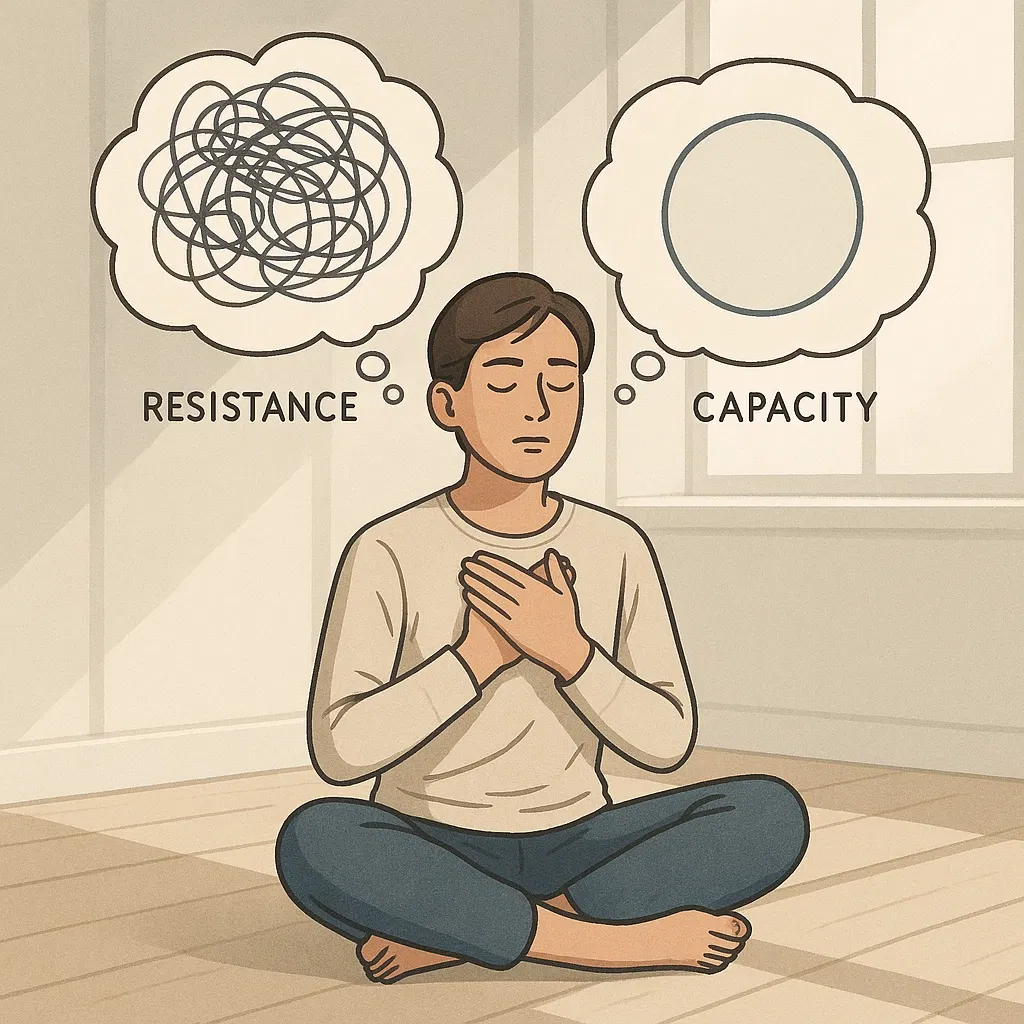
The goal isn't to live a life without stress. That’s a fantasy. The goal is to build a "bigger bucket": to increase your capacity so that the stress of life doesn't overflow your system.
Step 1: Own Your Vibration
The next time you’re about to snap at your partner, stop. Close your eyes. Don't look at them. Look in. Feel the tightness in your throat, the heat in your face, the fluttering in your gut. This is yours. It belongs to you. It is not their fault. By taking 100% responsibility for your current state, you stop the cycle of projection.
Step 2: Practice Co-regulation as Leadership
To improve relationships, you must become the anchor. When your partner is stressed, don't meet them in the clouds. Go to the ground. Deepen your breath. Relax your jaw. Use your calm system to invite theirs back to safety. This is how you heal connections without saying a single word. You can learn more about these foundational shifts through our Navigate programs.
Step 3: Expand Your Capacity
Most people spend their lives trying to avoid "bad" feelings. At Satori Prime, we teach you how to expand your system so you can hold it all: the joy, the grief, the rage, and the peace. When you get better at feeling, the world stops being a threat.
Step 4: The 28-Day Reset
If you feel like you’ve been living in a frazzled state for years, you need more than a "tip." You need a systemic overhaul. You need to rewire the way your body responds to the world. We designed the 28-Day Navigation specifically for this purpose: to move you from a state of constant reaction to a state of visionary presence.
A Visionary Way to Live
Imagine walking into your home after a long day. The kids are loud, your partner is tired, and the kitchen is a mess. In your old, frazzled state, this was a trigger for a blow-up.
But now? Your system is wide. You feel the chaos, but you don't become the chaos. You are the space in which the chaos happens. You offer a hug instead of a critique. You offer a deep breath instead of a sigh of annoyance.
This isn't just about "fixing" a relationship. This is about reclaiming your life. It’s about becoming the person who can handle the intensity of a high-performance life without losing your soul: or your family: in the process.
Stop trying to make yourself feel better. Get better at feeling. The peace you’re looking for isn't on the other side of your problems; it’s on the other side of your resistance.
Ready to dive deeper? Book your call with us today and let’s start the recalibration. Your family is waiting for the real you to come back online.