
Let’s get real for a second. Most high performers, the CEOs, the visionary entrepreneurs, the parents juggling a million things, are living their lives in a state of high-functioning anxiety. You might call it "drive." You might call it "hustle." But your body calls it a survival response.
You’re grinding through your to-do list, drinking your third coffee, and wondering why that elusive "flow state" feels like a rare visitor rather than your permanent residence. You’ve read the mindset books. You’ve tried the affirmations. But your heart is still racing, and your brain feels like it has fifty tabs open at once.
Here’s the Satori Prime truth: You cannot out-think a dysregulated nervous system.
At Satori Prime, we move beyond the "anti-mindset" trap. Mindset is just the software. Your nervous system is the hardware. If your hardware is overheating and glitching, no amount of positive thinking is going to make the program run faster. To access flow, that state of effortless brilliance and wealth capacity, you have to master your biology.
The Science of the "Stuck" High Performer
When you’re in high-stakes leadership, your nervous system is constantly scanning for threats. A missed deadline, a drop in revenue, or even a tense conversation with your partner can trigger the sympathetic nervous system (the "fight or flight" response).
While this response is great for running away from a saber-toothed tiger, it’s terrible for creative problem-solving and deep connection. In this state, your prefrontal cortex, the part of the brain responsible for leadership, logic, and flow, effectively goes offline. You become reactive, not proactive.
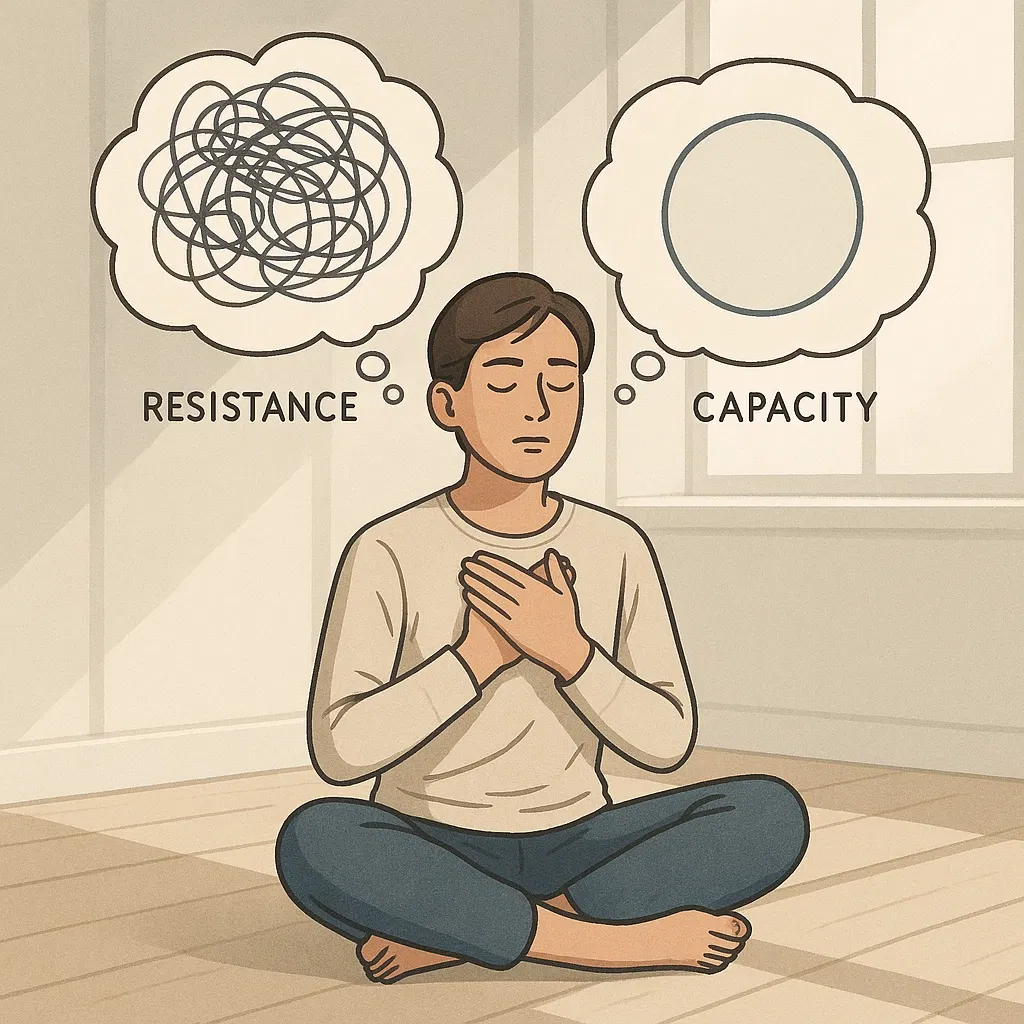
To move from "Resistance" to "Capacity," you need to learn how to signal safety to your body. When your body feels safe, it unlocks the parasympathetic nervous system (rest and digest) and allows you to enter the "Flow State" (the ventral vagal state).
Here are 5 actionable steps to regulate your system and reclaim your performance.
Step 1: Master Diaphragmatic Breathing (The Remote Control)
Your breath is the only part of your autonomic nervous system that you can consciously control. It is the "remote control" for your internal state. Most people breathe from their chest when they’re stressed, which actually reinforces the stress loop.
The Technique:
- Inhale through your nose for 4 seconds, letting your belly expand (not your chest).
- Exhale through your mouth for a count of 8.
- The secret sauce: The exhale must be longer than the inhale. This stimulates the vagus nerve, which tells your brain, "Hey, we aren’t dying. You can relax now."
For high performers, doing this for just two minutes before a big pitch or a difficult parenting moment can be the difference between a blow-up and a breakthrough.
Step 2: Environmental Orienting (The Reality Check)
When you’re anxious, your brain is living in a scary future or a painful past. Orienting brings you back to the only place where flow exists: the present.
How to do it:
Stop what you’re doing. Don't just look, see. Let your eyes wander slowly around the room. Find three things that are a specific color, say, blue. Notice the texture of the wall. Notice how the light hits the floor.
This simple act tells your amygdala that there is no immediate physical threat in your current environment. It breaks the "threat-scanning" loop and anchors you in reality.

Step 3: Grounding and Vagus Nerve Resets
High performance often feels like "living in your head." Grounding pulls that energy back down into your body. If you’re feeling scattered or overwhelmed, you need a physical circuit breaker.
The Satori "Quick Fixes":
- Cold Water Exposure: Splash ice-cold water on your face or hold an ice cube. This triggers the "mammalian dive reflex," which instantly slows your heart rate.
- The Basic Exercise: Interlock your fingers behind your head. Keeping your head straight, look as far to the right as you can with only your eyes. Hold until you yawn, sigh, or swallow. Repeat on the left. This physically resets the top of your spinal cord and your vagus nerve.
When you regulate your system, your wealth capacity expands. Why? Because you can handle more "charge": more responsibility, more money, and more complexity: without breaking.
Step 4: Sensory Engagement (The 5-4-3-2-1 Method)
Flow requires total sensory immersion. If you’re distracted by internal "noise," you can’t get into the zone. This technique is a favorite for leaders who feel their focus slipping.
Acknowledge:
- 5 things you see (a plant, a pen, a shadow).
- 4 things you feel (the chair against your back, your feet in your shoes).
- 3 things you hear (the hum of the AC, distant traffic).
- 2 things you smell (coffee, the air).
- 1 thing you taste (the mint you just had).
By the time you get to one, your brain has shifted from "alarm mode" to "observation mode." This is the gateway to the flow state.

Step 5: Bilateral Rhythmic Movement
Ever wonder why your best ideas come to you while walking? It’s not just the fresh air; it’s the bilateral stimulation. Moving both sides of your body in a rhythm integrates the left and right hemispheres of your brain.
Integration for Performance:
- Take a 10-minute walk where you consciously swing your arms.
- Try "tapping": alternately tapping your left and right shoulders.
- Gentle swaying or rhythmic stretching.
This movement helps process "stuck" emotional energy. In our coaching at Satori Prime, we see that leaders who embrace somatic movement are far more resilient than those who just "grind it out" at a desk.
From Performance to Mastery
Regulation isn't just about feeling "calm." It's about being powerfully present. It's about having the capacity to lead your family with love, even after a brutal day at the office. It's about looking at your bank account or your business's P&L and seeing data points instead of personal threats.
When you master your nervous system, you stop being a victim of your circumstances and start becoming the architect of your reality. You move from "improvement" to "transformation."
If you’re ready to stop the "mindset" games and actually change the way your body responds to the world, it’s time to go deeper. Most people spend their whole lives trying to fix their thoughts while ignoring the biological engine driving them. Don't be "most people."
Ready to Unlock Your Flow State?
You’ve spent years building your career, your family, and your life. But if you’re doing it from a place of chronic stress, you’re leaving 90% of your potential on the table. It’s time to upgrade your internal hardware.
We’ve designed a specialized protocol for high-achievers who want to master their internal state and skyrocket their leadership capacity.
Join our 'Nervous System Mastery' program today.
Stop reacting to your life and start creating it from a place of grounded, visionary power. Because you're a Satori Prime reader, we want to give you the tools to start this journey right now.
👉 Get 50% OFF Nervous System Mastery Here 👈
(Use this link to claim your exclusive discount and start your 28-day journey to a regulated, high-performance life.)

Final Thoughts for the Visionary Leader
Remember, your nervous system is the bridge between your vision and your results. A bridge that is under constant repair cannot support a heavy load. Strengthen the bridge, regulate the system, and watch as the "hard" things in your life suddenly become effortless.
Flow isn't a fluke. It's a physiological state you can learn to trigger at will. Step into your power.
To explore more about our philosophy on leadership and personal evolution, check out our blog or see how we work with leaders at Satori Prime for Leaders.